Category: Uncategorized

  • Systems within SART Exams: A moderated conversation with a SANE Examiner and Advocate

    by Macy Puckett

    This project is about systems and survivors. There is little to no information about Sexual Assault Response Team (SART) exams on campus websites, and if they are included, many direct students (inaccurately) straight to the hospital. 
     
    The purpose of SART exams is to conduct a forensic examination and gather evidence for a future case, as well as provide additional medical care. Given the nature of these exams, they rest on the intersection of legal and medical institutions as the police and hospitals. With the systematic nature of these exams, women of color are disproportionately more likely to experience shaming, discrediting, disbelief, biases, or refusal of care. An abundance of research suggests that women of color are more likely to experience interpersonal violence, but less likely to access care. Despite the exams being free, socioeconomic factors play a huge role in accessing this care, such as limiting transportation access, being able to take time off work, and finding childcare. When interacting with law enforcement prior to or after the exams, narratives reveal patterns of women often being turned away from medical services due to misconceptions about what a “real” assault looks like. Information is the first step for access. 

    Knowing who performs these exams, and how they are performed, matters. I interviewed a SANE nurse and Project Sister advocate to understand what these exams look like in the inland empire. Nurse Jennifer Rivera and Advocate Gabriela de la Rosa talked through how an exam begins, what takes place before and after, where it takes place, what it consists of, and what happens after. Gabriela talks through her role as an advocate during the exam, making sure she clarifies how the advocate can be there for the survivor in the room. I urge viewers to notice the role of law enforcement in these exams, and think about the barriers that exist for those often disadvantaged by systems that historically neglect those at their most vulnerable.
     
  • BPD: The Diagnostic Blinds​

    by Anonymous

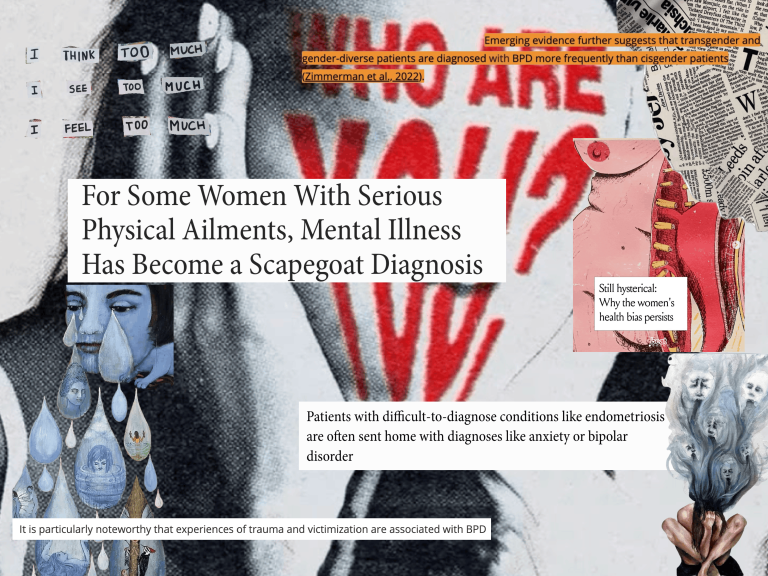
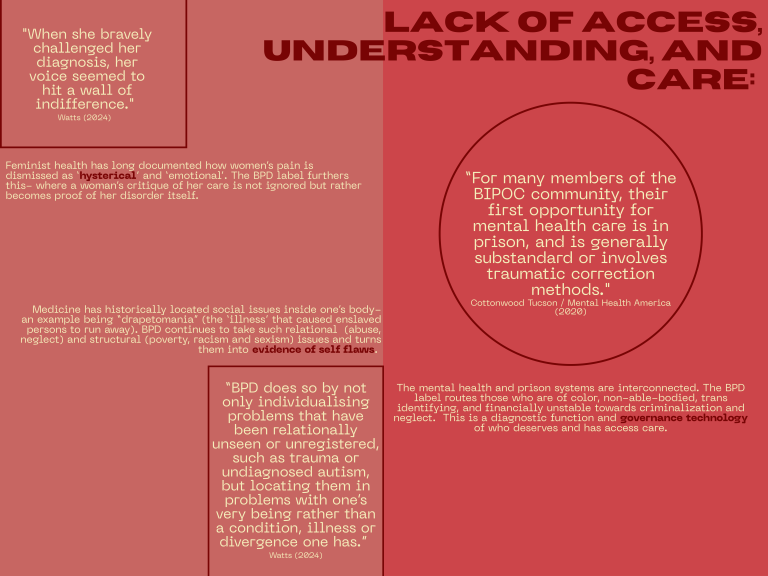
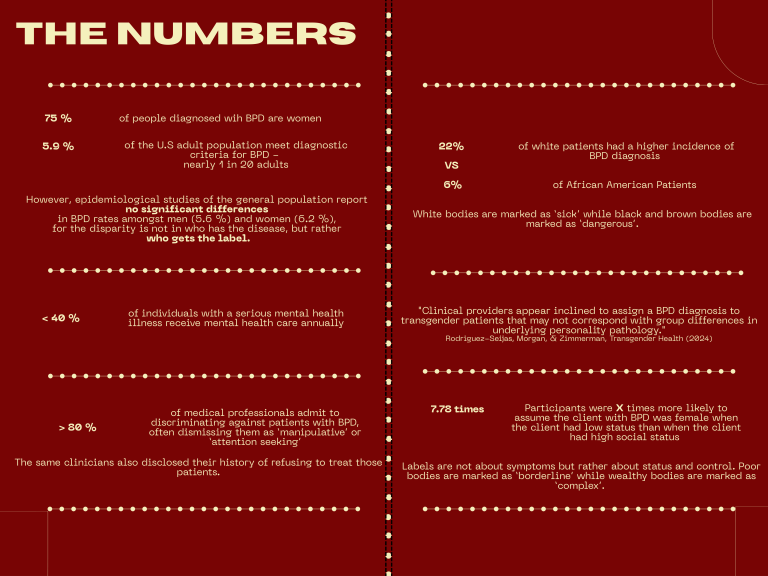
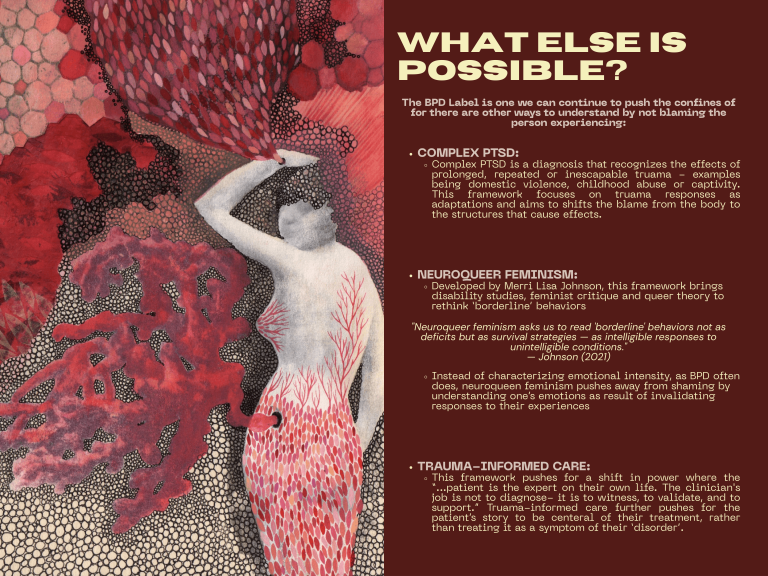
    In my project, I analyze Borderline Personality Disorder as a governance technology that disproportionately pathologizes women’s responses to trauma while concealing the structural violence that produces their distress. Drawing on intersectional feminism, epistemic injustice, and clinical Studies, I argue that the BPD label does not merely describe but sorts bodies into those deemed worthy of care (white, affluent, cis women) and those who are deemed not (disporportionately being Black, Brown, trans, disabled, and poor bodies). 
     
    My zine, you will find my zine in digital format, where I break down the gendered history of BPD, the statistical evidence of diagnostic bias, and the lived experiences of those misdiagnosed and dismissed. My goal is to engage readers, whether students, clinicians, or community members, with the tools to question the power of a clinical label, believe survivors, and advocate for trauma-informed alternatives. I encourage you to read each page question at the heart of this project: What do clinical diagnoses do, and for whom?
  • Reproductive Governance and Medical Paternalism in Japan: The Politics of NorLevo’s Approval

    by Emily Mito


    From the author

    This academic paper examines contemporary and historical reproductive governance in Japan through the lens of access to contraceptive pills. Centering on the Japanese government’s October 2025 decision to convert NorLevo, an emergency contraceptive pill, to behind-the-phermacy-counter status, the paper investigates how political and medical institutions continue to regulate women’s bodily autonomy through medical paternalism. Although the policy change—achieved largely through dedicated feminist activsim—marked an important step toward addressing Japan’s decades-long delay in access to emergency contraception compared to global standards, significant barriers remain. The high cost of the pill (approximately $50 for a single dose) and privacy concerns surrounding the requirement to take the medicine in front of a pharmacist in a public setting continue to restrict meaningful access. Furthermore, analysis of the decade-long evaluation process reveals that committee discussions often prioritized the supervision of women’s sexuality and reproductive behavior over the protection of reproductive rights.

    The paper then trances the historical continuity of medical and institutional paternalism over women’s bodies through several key moments in Japan’s reproductive governance:  the legalization of abortion under the Eugenics Protection Law (1948), the nearly forty-year delay in approving oral contraceptives during the late twentieth century, the rapid approval of Viagra in 1999, and state-led censorship surrounding sex education in schools during the early 2000s. Together, these cases reveal how reproductive healthcare in Japan has repeatedly been shaped by demographic concerns, moral regulation, and institutional authority rather than by women’s reproductive autonomy. 

    Throughout the paper, I argue that medical paternalism in Japan has operated through three interconnected mechanisms: infantilizing women, pathologizing female sexuality, and prioritizing perceived public and national interests over reproductive rights. Male-dominated political and medical institutions have historically regulated and stigmatized women’s sexuality and bodily autonomy by restricting access to contraception and comprehensive sex education while simultaneously normalizing male sexuality. 

    This research also carried personal significance for me as someone who grew up within the very silence surrounding sexuality and reproductive knowledge examined in this paper. Throughout my education in Japan, sex education classes separated by gender consistently presented condoms as the primary—and almost the only—form of contraception. Even when low-dose oral contraceptives were discussed, their contraceptive function was largely omitted in favor of emphasizing their therapeutic use for menstrual symptoms. Conducting this research led me to recognize that the stigma, silence, and lack of confidence surrounding sexual literacy that I continue to internalize were not individual shortcomings or merely “cultural” legacy. Rather, they were systematically produced through institutional restrictions on sexual education and reproductive healthcare later mobilized to justify continued medical paternalism over women’s bodies. I hope this project invites both Japanese and international women and girls to critically examine the institutional and medical structures that continue to regulate our bodily autonomy under the language of protection and morality. 

    INTRODUCTION

    In October 2025, the Japanese government switched the status of NorLevo, an emergency contraceptive pill, from prescription-only to behind-the-pharmacy-counter (BPC) medicine. The pill became available at 7,000 pharmacies across Japan, catching up to a decades-long delay from the global standard. Although this change significantly improves access to emergency contraception—which is crucial to women’s bodily autonomy—the delayed approval process itself reveals enduring paternalistic control embedded in Japan’s reproductive politics.

     
    My aim in this paper is to move the conversation beyond questions of access toward a reproductive justice framework, which, as articulated by Marlene Gerber Fried and Loretta J. Ross, emphasizes not only access to reproductive health care but also bodily autonomy and freedom from institutional control over reproduction. By closely analyzing the institutional discourse surrounding NorLevo’s approval within the broader context of Japan’s postwar reproductive politics, I argue that the delayed approval of behind-the-phermacy-counter access reflects the persistence of medical paternalism and institutional governance over women’s reproductive bodies. Rather than demonstrating a genuine state commitment to reproductive autonomy, the 2025 approval emerged through sustained feminist activism while preserving institutional logics that position women as subjects to be monitored, educated, and judged by medical authorities. The following sections examine three mechanisms through which this paternalism operates: the infantilization of women, historical population governance, and the pathologization of women’s sexuality.

    What is at Stake

    NorLevo is an emergency contraceptive pill (ECP) manufactured by Daiichi Sankyo Health Care  (Figure1). Its primary component is Levonorgestrel, a synthetic hormone that prevents pregnancy by suppressing ovulation. The pill has an effectiveness rate of approximately 84% when taken within 72 hours after unprotected sexual intercouse. Levonorgestrel medicines are available either behind or over the counter in around ninety countries while only thirty-four countries continue to require prescriptions. Five years after NorLevo was approved in 2011, a request was submitted to the government’s Evaluation Meeting Regarding the Conversion of Medical-grade Products to General-use Products to switch the medicine to over-the-counter (OTC) status. However, the government concluded that Japanese society was still “premature” in terms of sex education and awareness of emergency contraception and postponed the policy change.

     
    In addition to pressure from international health organizations advocating greater accessibility, sustained activism by feminist groups such as Pilcon and Project #Why Isn’t There—including signature campaigns, public education efforts, online surveys, and information-sharing initiatives—eventually pushed the government to change NorLevo’s status in October 2025. Nevertheless, significant limitations remain.The law requires users to take the pill in front of a certified pharmacist, raising concerns about privacy and preventing women from obtaining it in advance. The high price of 7,480 JPY (50 USD) also continues to limit equitable access. More importantly, the discourse surrounding the approval process itself reveals enduring medical paternalism over women’s reproduction and sexualities in Japan.

    Figure 1: Package of NorLevo produced by Daiichi Sankyo Health Care

    Medical paternalism and infantilization of women

    Discussions surrounding the conversion of NorLevo from prescription-only to OTC status took place between 2017 and 2025 at the Evaluation Meeting Regarding the Conversion of Medical-grade Products to General-use Products hosted by the Ministry of Health, Labour and Welfare. Although membership shifted slightly over time, the committee consistently consisted of roughly twenty doctors and scholars, among whom only four members were women. Through an examination of the committee transcripts, I argue that members repeatedly positioned women as lacking the knowledge, discipline, and rationality necessary to manage their own reproductive health through NorLevo, thereby legitimizing continued medical supervision.

    Committee members frequently justified women’s supposed unfitness for autonomous access to emergency contraception by pointing to two conditions: inadequate sex education and the relatively uncommon use of oral contraceptives in Japan compared to Europe and the United States. A board member of the Japan Association of Ob-gyns argued that “sex education itself is far delayed in Japan,” adding that even his pharmacist wife was “completely clueless” (“チンプンカンプン”) regarding contraceptive pills. This statement framed not only consumers but also pharmacists as incapable of responsibly managing emergency contraception, thereby reinforcing doctors’ exceptional authority over reproductive healthcare.

    Another physician similarly insisted that emergency contraceptives required institutional supervision because medical facilities provided opportunities for “appropriate sex education” and “patient education” that pharmacies could not offer. Here, the physician positioned himself not only as a healthcare provider but also as a moral and educational guardian responsible for regulating women’s contraceptive behavior and sexual practices.

    Committee members also repeatedly framed structural conditions—such as restricted access to contraception and inadequate sex education—as evidence of women’s personal incapacity. One doctor argued that OTC access might be acceptable in the United States because women there were accustomed to regular oral contraceptive use, whereas Japanese women “rarely use oral pills” due to Japan’s “culture and environment.” Such comments transformed historically produced institutional conditions into individualized or cultural deficiencies.

    The expert authority asserted throughout these discussions was significantly destabilized by the interventions of feminist activists who joined the meetings beginning in October 2021. Sakiko Enmi, Asuka Someya, and Kazuko Fukuda, co-representatives of the Citizen-led Project to Make Emergency Contraceptives Available at Phermacies (緊急避妊薬の薬局での入手を実現する市民プロジェクト), presented the “ECP Fact Check,” which compared previous committee discussions and publications by the Japan Association of Obstetricians and Gynecologists with global medical guidelines produced by the WHO, International Federation of Gynecology and Obstetrics, and International Consortium for Emergency Contraception.

    The activists addressed claims raised during earlier meetings concerning potential risks such as ectopic pregnancy and fetal malformation and demonstrated that no scientific evidence supported those concerns. They also cited research showing that women are capable of correctly understanding and using emergency contraceptives without medical supervision. According to WHO guidelines, emergency contraception does not need to be placed under strict medical management. The fact check was significant not only because it corrected misinformation used to oppose OTC approval, but also because it challenged the expertise doctors had used to justify institutional control over access to the pill.

    Importantly, the activists reframed access to emergency contraception as a right rather than a reward for “responsible” sexual behavior. Sakiko Enmi argued that “regardless of the level of sex education, all women and girls have the right to access emergency contraception,” emphasizing that no evidence supports the claim that comprehensive sex education must be a prerequisite for access. She further rejected the idea that women’s cultural background, frequency of contraceptive use, or sexual behavior should determine whether they are “deserving” of emergency contraception. Rather than positioning doctors as judges who determine women’s eligibility for reproductive healthcare, the activists argued that women themselves should be the primary decision makers regarding their own bodies and reproduction, while medical professionals should serve as supporters rather than gatekeepers. 

    Public response further undermined the committee’s claim that Japanese society was “premature” for less restricted access to emergency contraception. Public comments collected between December 2022 to January 2023 received more than 46,000 submissions, approximately 98% of which supported OTC conversion. Considering that public comment periods in Japan often receive only around ten submissions, this unprecedented level of participation demonstrated widespread public concern regarding reproductive autonomy and substantial support for expanding access to emergency contraception. 

    This section has demonstrated how medical and political stakeholders framed women as insufficiently educated and incapable of independently managing their own reproduction and sexuality, thereby justifying continued medical supervision. However, feminist interventions and overwhelming public support revealed an alternative framework: women do not need to earn access to emergency contraception through demonstrating their moral discipline or educational achievement. Rather, access to emergency contraception should be understood as a fundamental reproductive right. In the following section, I trace the historical roots of this contemporary medical paternalism through Japan’s postwar reproductive governance. 


    Public Good Over Reproductive Rights

    Contemporary debates surrounding NorLevo reproduce a longer history of reproductive governance in Japan in which women’s reproductive healthcare was regulated primarily according to demographic and institutional priorities rather than bodily autonomy. The delayed approval of emergency contraception is therefore not an isolated policy failure but part of a broader historical pattern in which the state and medical authorities treated reproduction as a matter of national management. Japan’s nearly forty-year delay in approving oral contraceptives between 1961 and 1999—which made the country one of the last industrialized nations to legalize the pill—provides important historical context for understanding the contemporary regulation of emergency contraception. As Tiana Norgren argues, the prolonged restriction of oral contraceptives reflected the priorities of political and medical elites rather than concerns centered on women’s reproductive autonomy.

    In the postwar period, both Japanese policymakers and American occupation authorities viewed overpopulation as a threat to economic recovery, legalization of abortion under the 1948 Eugenics Protection Act. However, as suggested by the law’s title, abortion access was framed not as a matter of women’s rights but as a tool of demographic management shaped by eugenic concerns regarding the “quality” and quantity of the population. The law remained in place under the same name until 1999. Even while abortion was legalized, some policymakers feared “reverse selection,” the idea that birth control would reduce reproduction among the educated and economically stable while poorer populations continued reproducing. The coexistence of relatively accessible abortion and heavily restricted contraception therefore revealed a system designed to keep productive decision-making under medical supervision rather than in women’s own hands.

     
    By the late twentieth century, anxieties surrounding overpopulation shifted into fears of population decline. During the “1.57 shock” of 1990, when Japan recorded a historically low birthrate, policymakers and medical elites argued that broader contraceptive access might further reduce fertility and threaten the future labor force. Although demographic priorities changed over time—from suppressing population growth in the postwar era to encouraging reproduction during the birthrate crisis—the underlying logic of reproductive governance remained consistent. Women’s reproductive healthcare continued to be evaluated according to national demographic concerns rather than reproductive autonomy. The contemporary NorLevo debate reproduces this logic by framing access to emergency contraception not as a fundamental reproductive right, but as a matter that must be balanced against broader social and national concerns—such as concerns for illegal resales, delay in sex education, and fear for increase in “inappropriate” sex practices.

     
    Professional medical organizations also played a central role in delaying contraceptive approval. As Norgren notes, groups such as Nichibo, the designated abortion provider’s group under the Eugenics Protection Act, and the Japan Association of Obstetricians and Gynecologists feared that less expensive oral contraceptives would reduce demand for abortions, which remained a major source of income for many of the doctors. Yet these professional interests were publicly reframed as concerns for women’s health and social morality. Physicians emphasized potential side effects, infertility, and disruptions to women’s “natural” hormonal balance while also warning that accessible contraception could encourage “free sex” among young people. In this way, institutional authority over women’s reproductive bodies was justified through the language of protection and public responsibility. The rhetoric of protecting women’s health and morality closely resembles contemporary committee discussions surrounding NorLevo, in which medical authorities continued to portray supervision and restricted access as necessary safeguards against women’s health and supposedly irresponsible sexual behavior.


    Even after the low-dose birth control pill was approved in 1999, access remained highly surveilled through mandatory checkups every three months accompanied by pelvic examinations and tests for sexually transmitted diseases and uterine cancer. These requirements imposed substantial financial and emotional burdens on women seeking pills. Rather than granting reproductive autonomy, approval institutionalized continued monitoring of women’s bodies through medical authority. This historical context debunks contemporary committee claims that Japanese women are “culturally” unprepared for autonomous contraceptive access because they are unfamiliar with oral contraceptives. The limited familiarity with contraceptive pills repeatedly cited during NorLevo debates was not simply cultural but is the product of decades of institutional restriction and medical gatekeeping. While the previous section demonstrated how medical authorities justified paternalistic control as a means of protecting individual women’s health and moral sexuality during debates over NorLevo’s OTC conversion, the history of delayed contraceptive approval reveals that doctors also positioned themselves as guardians of broader public and national interests.

    Stigmatizing Women’s Sexuality

    Contemporary debates surrounding NorLevo and earlier restrictions on oral contraceptives both relied on the construction of women’s sexuality as socially dangerous, irresponsible, and in need of institutional supervision. In these discussions, increased access to contraception was repeatedly associated with fears of “free” or morally improper sex, allowing medical authorities and government officials to frame reproductive control as a matter of public protection rather than women’s bodily autonomy. The final section examines how moral rhetoric surrounding contraception was reinforced through the suppression of sexual education in the 2000s and through gendered double standards that normalized male sexuality while stigmatizing women’s sexual autonomy.

     
    Committee discussions surrounding NorLevo frequently portrayed emergency contraception not merely as a medical issue, but as a potential facilitator of morally irresponsible sexuality. For instance, one committee member warned against the possible “exploitation” (悪用) of the pill’s contraceptive effects and argued that easier access through pharmacies or online retails could reduce condom use and consequently increase the spread of sexually transmitted diseases. The same speaker further emphasized the need to protect underage girls from the casual sexual behavior that over-the-counter access might supposedly encourage. These concerns closely echoed earlier arguments used to oppose oral contraceptives in the late twentieth century, when medical authorities similarly warned that accessible contraception would promote “free sex” among young people and threaten public morality. In both historical and contemporary discussions, anxiety about the possibility that women might exercise sexual autonomy outside institutional supervision. Increased contraceptive access was therefore framed as a threat not only to public health but also to existing “moral” order. These moral anxieties were further intensified by broader political efforts to suppress open discussions of sexuality and reproductive knowledge in Japan.

     
    Hiroko Hirose examines the widespread political backlash against school sex education in the early 2000s, which resulted in the long-lasting censorship surrounding discussions of sexuality and reproduction. During a Diet debate, Democratic Party politician Eriko Yamatani criticized what she described as “excessive” sex education in schools, even questioning the validity of teaching “self-determination for sexuality.” Arguing that such instruction failed to consider students’ developmental stages, she insisted that “parents, religious leaders, and developmental psychology experts” should determine what kinds of sexual knowledge appropriate for children. Her criticism received broad support from Diet members as well as Prime Minister Junichiro Koizumi. Yamatani also specifically targeted the authorized textbook Love and Body, which was widely used in primary and secondary school sex education. She condemned the textbook for teaching girls “secret ways” to obtain oral contraceptives by using menstrual pain as an excuse and accused it for “encourag[ing] girls to take the Pill.” Such criticisms framed contraceptive access as immoral and essentially pathologized sexuality of teenage girls. The textbook was ultimately withdrawn and went out of print following the controversy.

     
    Criticism of sex education did not stay within the Diet but extended into a state-led disciplinary action against educators accused of promoting “excessive” sex education. In 2003, Nanao Special Education School came under investigation after criticism from a member of the Tokyo Metropolitan Assembly. Education materials were confiscated, and two months later, 102 teachers in Tokyo—including educators at Nanao Special Education School—were formally punished in part because of their sex education programs. Hirose argues that these campaigns produced a lasting “depressing atmosphere” surrounding sex education, encouraging widespread self-censorship among educators. This history reveals that the lack of sexual education frequently cited during NorLevo debates as evidence that Japanese women were unprepared for autonomous contraceptive access was not merely cultural or individual, but institutionally produced. In other words, the state first restricted access to comprehensive sexual knowledge and later used women’s supposed lack of reproductive literacy to justify continued medical supervision over contraception.

     
    This contradiction also exposes the fundamentally gendered nature of sexual regulation in Japan. As the previous discussions demonstrate, women’s sexuality was frequently stigmatized as immoral. At the same time, male sexuality remained broadly normalized and commercially visible through the widespread circulation of pornography and the hypersexualization of women and girls in popular media culture. Although these broader cultural dynamics extend beyond the scope of this paper, a similar double standard can be observed within pharmaceutical governance itself. The most striking example lies in the contrast between the nearly forty-year delay in approving oral contraceptives and the remarkably rapid approval of Viagra, a medication for erectile dysfunction in men, in only six months. In January 1999, Viagra was approved despite some remaining medical concerns. At this time, the low-dose oral contraceptive pill was still stalled in evaluation after nearly forty years since the original authorization request in 1961. This double-standard provoked fierce criticisms from female politicians, feminist activists, and the global world, embarrassing the Japanese government and reportedly contributing to the eventual approval of the low-dose pill later that same year. This disparity demonstrates that Japanese institutions did not oppose sexuality itself, but rather sought to regulate women’s sexual autonomy in particular. While pharmaceutical interventions supporting male sexuality were treated as legitimate medical concerns deserving swift approval, contraceptives associated with women’s sexual agency remained subject to prolonged institutional surveillance and paternalistic control.

     
    Throughout the paper, I examined the politics surrounding the recent conversion of the emergency contraceptive pill NorLevo to behind-the-pharmacy-counter status in Japan. Analysis on institutional discourse throughout the decade-long approval process revealed the persistence of medical paternalism and patriarchal governance that extends far beyond a single policy debate and is deeply rooted in Japan’s postwar reproductive governance. Male-dominated political and medical institutions have historically regulated and stigmatized women’s sexuality and bodily autonomy through restrictions on contraceptive access and comprehensive sex education while simultaneously normalizing male sexuality. Both historical and contemporary debates surrounding reproductive healthcare demonstrate how policy makers and medical authorities repeatedly prioritized notions of “public good”—including demographic management, economic concerns, and the maintenance of socially disciplined sexuality—over women’s reproductive rights and bodily autonomy.

     
    Positioned within the reproductive justice framework, this paper sought to move discussions on NorLevo beyond the narrow issues of contraceptive access toward a broader examination of institutional control over women’s bodies and sexualities. At the same time, this paper does not address the ongoing reproductive justice issues that disproportionately affect economically and racially marginalized women in Japan, including part-time workers, single mothers, and migrant women, and women living in rural areas. These inequalities continue to shape who can meaningfully access reproductive healthcare even after formal policy changes such as NoeLevo’s approval as behind-the-counter medicine.

    This research also carries personal significance for me as someone who grew up within the very silence surrounding sexuality and reproductive knowledge examined in this paper. Throughout my education in Japan, sex education classes separated by gender consistently presented condoms as the primary—and almost the only—form of contraception. Even when low-dose oral contraceptives were discussed, their contraceptive function was largely omitted in favor of emphasizing their therapeutic use for menstrual symptoms. I vividly remember the shock I felt during orientation at the high school in Connecticut to which I transferred, when students were openly introduced to multiple forms of contraceptive care available through the school health center. What struck me most was not only how little I knew about contraception, but also how openly and confidently these topics could be discussed. Conducting this research led me to recognize that the stigma, silence, and lack of confidence surrounding sexual literacy that I continue to internalize were not individual shortcomings or merely “cultural” legacy. Rather, they were systematically produced through institutional restrictions on sexual education and reproductive healthcare later mobilized to justify continued medical paternalism over women’s bodies.


    BIBLIOGRAPHY

    Daiichi Sankyo. “‘日本初のOTC緊急避妊薬「ノルレボ®」を新発売’ [Launch of ‘NorLevo®,’ Japan’s First over-the-Counter Emergency Contraceptive].” News Release, December 18, 2025. https://www.daiichisankyo-hc.co.jp/content/000141490.pdf.

    European Consortium for Emergency Contraception. Emergency Contraception in the World. n.d. https://www.ec-ec.org/emergency-contraception-in-the-world/.

    Hirose, Hiroko. “Consequences of a Recent Campaign of Criticism against School Sex Education in Japan.” Sex Education 13, no. 6 (2013): 674–86. https://doi.org/10.1080/14681811.2013.804405.

    Jonathan Watts. 34 Years on, Japan Finally Prepares to Swallow Pill. March 3, 1999.

    Kazuhiro Fujiya and Kazuya Goto. “緊急避妊薬「市販化を」 異例のパブコメ4万6千件、賛成の声多く” [Calls for over-the-Counter Availability of Emergency Contraceptives Receive an Unprecedented 46,000 Public Comments, with Many in Favor]. May 12, 2023.

    Marlene Gerber Fried and Loretta J. Ross. Abortion and Reproductive Justice (An Essential Guide for Resistance ). University of California Press, 2025. https://doi.org/10.2307/jj.33476836.

    Masako Tanaka. “‘社会的再生産をめぐる日本社会の矛盾 : 移民女性の身体から見るリプロダクティブ・ジャスティス’ [Contradictions in Japanese Society Regarding Social Reproduction: Reproductive Justice as Seen Through the Bodies of Immigrant Women].” 現代思想 53, no. 15 (2025): 172–83.

    Ministry of Health, Labour, and Welfare. July 26, 2017: Second Evaluation and Review Meeting on the Conversion of Products from Medical Use to General Use/Products Requiring Guidance. 2017. https://www.mhlw.go.jp/stf/shingi2/0000176856.html.

    Ministry of Health, Labour, and Welfare. October 4, 2021: Seventeenth Evaluation and Review Meeting on the Conversion of Products from Medical Use to General Use/Products Requiring Guidance. 2021. https://www.mhlw.go.jp/stf/shingi2/0000205207_00015.html.

    Ministry of Health, Labour, and Welfare. Seating Chart: Second Meeting of the Evaluation and Review Committee on the Conversion of Medical Products to Products Requiring Guidance/General Use. 2017. https://www.mhlw.go.jp/file/05-Shingikai-11121000-Iyakushokuhinkyoku-Soumuka/0000172625.pdf.

    Ministry of Health, Labour,and Welfare: Pharmaceutical Affairs Bureau, Drug Review and Management Division. “緊急避妊薬のスイッチOTC化について” [Regarding the Switch to OTC Status for Emergency Contraceptives]. 2025. https://www.mhlw.go.jp/content/11120000/001622311.pdf.

    Naoko Kinoshita. The Glacier Generation’s Sexual and Reproductive Health and Rights, Juxtaposed with Reproductive Justice: An Analysis of Bound Opportunities for Single, Contract Japanese Female Workers. April 2, 2025. https://chikushi-u.repo.nii.ac.jp/records/2000090.

    Tiana Norgren. Abortion before Birth Control: The Politics of Reproduction in Postwar Japan. Princeton University Press, 2001. https://doi.org/10.2307/j.ctv17db3mf.

    緊急避妊薬の薬局での入手を実現する市民プロジェクト [A citizen-led project to make emergency contraceptives available at pharmacies]. Emergency Contraceptive Pill Fact Check. 2021. https://kinkyuhinin.jp/wp-content/uploads/2021/09/Factcheck202109.pdf.

    Resources

  • Birth Control Through The Ages

    by Caroline Crosnoe

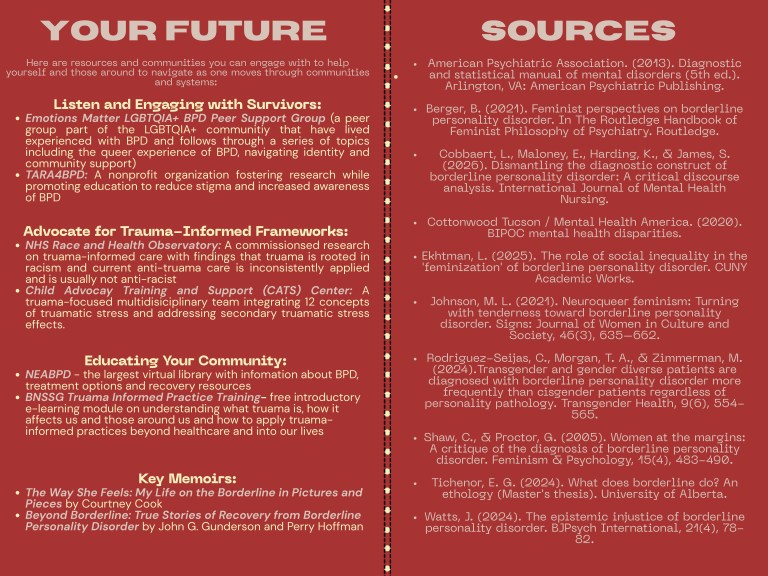
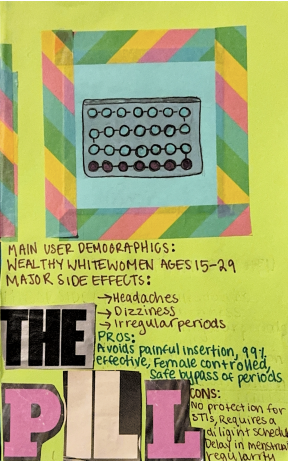
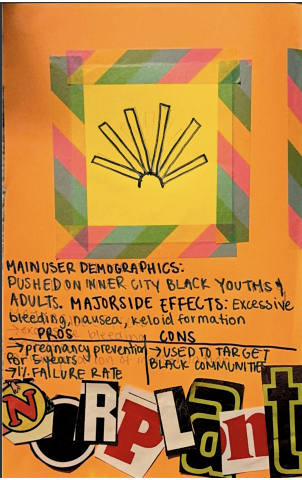
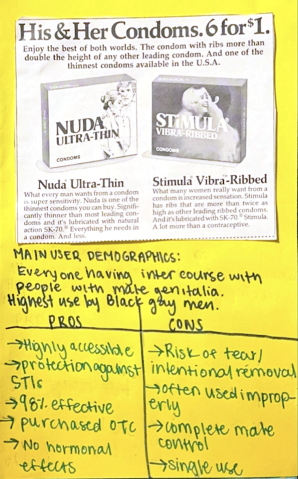
    For my generation, the most common form of birth control is the male condom, one that gives women zero control over family planning. While the Pill is also frequently used, it is advertised predominantly to women, rather than the comprehensive audience that condoms reach. I recognized that the exposure to different forms of birth control followed standard patriarchal systems and standards, so I wanted to explore both the history and target demographics of various types of family planning. What I discovered was largely unsurprising: birth control, which is now thought of as a progressive tool, has not always been enforced with the well-being of women in mind. I wanted my zine to reflect the injustices of the history of birth control enforcement. While there are major benefits to the overall population, specifically a newfound autonomy for women and entry to the workforce, the original intent of certain forms of birth control was to control minority communities and limit their reproductive rights. 
     
    For example, the release of Norplant was almost instantly manipulated into a tool to promote the sterilization of Black women and teenagers. Additionally, I found continuities between experimentation on enslaved women without informed consent and clinical trials for Norplant and the Pill in the Global South. While these minority communities were directly impacted by the development and rollout of various family planning methods, they were also at the forefront of contraceptive and sexual education advocacy. After the discovery of HIV as a sexually transmitted disease, LGBTQ+ advocacy encouraged condom use across gender, racial, and sexual orientation lines. In addition to the zine, I have included a write-up of the history, target demographics, pros and cons, and major side effects of the Pill, condoms, and Norplant. This contains a chart summarizing both the zine and the write-up, with QR codes of additional family resources inside.
  • Doulas — Full-Spectrum Feminist Careworkers

    by Liliana Watkins and Sophia Gonzalez


    From the author

    The following paper and website provide insight into the history of doulas, the roles they play in reproductive care, and their usage of social justice frameworks and advocacy models help mediate failings of the medical-industrial system. Through interviews with practicing doulas and OB/GYNs, as well as resource maps by state, we examine the modern role of doulas in healthcare.

    The term doula is derived from the ancient Greek word doulē, which translates to ‘female slave.’ This word was first adopted by Dana Raphael in the 1960s, who used it to describe women that provide postpartum support for their communities, including mothers, sisters, grandparents, healers, and midwives. The meaning of this word has evolved over time, and, in many ways, so has the role of the doula. Regardless, the primary purpose of the doula, that being to provide maternal support, has persisted. The following paper provides insight into the history of doulas, the roles they play in modern reproductive care, and their usage of social justice frameworks and advocacy models help to bridge the gaps in modern medical care. Through an analysis of patient narratives and interviews with practicing doulas, we aim to challenge the stigmas present in the medical system that undermine the historical and present role of doulas in health care.

    In order to understand the integral role doulas play in modern reproductive care, their historical significance must be acknowledged: modern doula practices emerged from the birth work historically provided by Black and Indigenous women within their communities. In seventeenth century United States, enslaved women cared for others lacking access to privileged care. These birth workers were often viewed as spiritual community healers, and provided pre-, intra-, and post-partum technical support, and also played key roles in the maintenance of birthing records.

    After emancipation in the nineteenth century, most doctors refused to provide care for Black patients, so Black women continued to seek support from doulas. However, simultaneously, the gynecological practices that would later become “modern” reproductive medicine were being developed through experimentation on enslaved women. This torture, by men like Dr. Marion Sims, formed birthing and reproductive health practices that consolidated medical authority to male doctors. With these, birthwork was no longer communal, nor focused on the wellbeing of the mothers.

    Around the turn of the 20th century, the rise of biomedicine marked the United States’ rejection of traditional, symptom-based care. Western society quickly deemed these experimental, “scientific” practices the most objective and valid form of medical care. White, male physicians seized control of women’s bodies and medical autonomy, and, in doing so, trumped the traditional community care that was built by Black and indigenous doulas and midwives. The shift was drastic. In the year 1990, approximately fifty-percent of births were attended by midwives or doulas, largely in African American and immigrant communities. By 1930, these “alternative” care practitioners were only present at fifteen percent of births. Officials blamed Black doulas’ supposedly “nonscientific” methods for undesired pregnancy outcomes, and used legislation and public health campaigns to limit their practices. Community-informed medical care, especially the work of doulas, was branded as dirty and unscientific so that a male-dominated biomedicine could appear modern, scientifically-backed, and natural. Soon enough, biomedicine became hegemonic, and the white coat became a symbol of Western biomedical superiority. As such, all other care workers were marginalized— especially doulas.

    With this widespread shift in attitude, alongside restrictive, state-controlled abortion legislation, came a shift in the services doulas provided. Instead of solely helping birthing patients, doulas began helping patients seeking abortion services. One example of their impact is the work of The Jane Collective, an underground abortion network that emerged out of Chicago in the nineteen sixties. This network sought to provide medical care for women seeking to terminate their pregnancies. The collective started when a nineteen-year old University of Chicago student helped her sister’s friend find a doctor who was willing to perform an abortion. Growing patient demand drove members of the collective to begin performing abortions alongside formally-trained doctors. Then came an influx of doulas, who provided critical technical and emotional support. Lauren Mitchell and Mary Mahoney, the authors of The Doulas: Radical Care for Pregnant People, write: “What we were most struck by…was how much support and care was exchanged between the members of Jane and their clients who had little to no anesthesia to offset the pain.” This, again, emphasizes the importance of whole-person, educational and emotional support through medical experiences. Doulas provide exactly that.

    Nearly two decades later, in 1994, came the Reproductive Justice (RJ) movement. Pioneered by twelve Black women of color, RJ advocates sought to redefine reproductive care, and recognized the failings of previous abortion-advocacy efforts that served primarily middle-class white women. Bridging and redefining existing feminist work, RJ advocated for reformation of all care, evaluating clinical, legislative, and institutional practices through a lens of social justice. Regarding childbirth and reproductive care; 

    • “The reproductive justice movement promotes the idea that, in a lifetime, a person might experience the full spectrum of reproductive health decisions, that these decisions are linked to other intersecting factors in their life, and that any decision made should be respected and protected.” Mahoney, M., & Mitchell, L. (2016). 

    Due to their role as community-responders, as well as medical advocates, doulas are uniquely positioned to facilitate this work. Though doulas are most recognized for their role in childbirth, their modern practice spans a much wider range of pregnancy outcomes and medical experiences. Later in The Doulas, Mahoney and Mitchell describe full-spectrum doulas who provide emotional and technical support across pregnancy, birth, adoption, abortion, and death. Their doula care model strongly reflects reproductive justice principles:

    • “Racism can distort a birthing or adoption experience. Transphobia can lead to the denial of vital healthcare. Prejudice against immigrants can divide families through deportation. Misogyny can reduce pregnant women to walking wombs without rights. These are all reproductive justice issues, and doulas are the birth justice wing of our movement. Doulas understand the unique nature of each person’s situation. At the same time, they comprehend the systemic factors that affect these experiences, such as race, age, English proficiency, citizenship, gender identity, class, and the host of integrative—not additive— forces that contour pregnancy experiences. They don’t shy away from naming oppressions—white supremacy, colonialism, xenophobia, homophobia, transphobia— yet they are not there to preach, but to serve. Their actions to support each and every pregnant person speak louder than any polemic on reproductive oppression or the medical industrial complex.” Mahoney, M., & Mitchell, L. (2016). 

    By these tenets, doulas are able to help patients reclaim autonomy denied by cold, sometimes dehumanizing medical practices. Moreover, through education, comfort, and advocacy, they are uniquely positioned to support every individual’s reproductive experience in the context of the social conditions that shape it.

    One community doula organization that works to address racial inequities is Chicago Birthworks Collective (CBC). CBC connects BIPOC families with doulas from the community who support and advocate for them during pregnancy, birth and postpartum. CBC was founded by Tayo Mbande and her mother, Toni Taylor. Tayo had her first child soon after graduating from college, and then her second child two years later. Both of her pregnancy and birth experiences were positive; she says: “things had gone much better for me than a lot of people who were older than me, had a greater socioeconomic status than I did, had been married longer than me.” Despite the fact that Tayo did not work with a certified doula, she remarks: “My mom played the role of doula. Everyone needs one of these. She answered all my questions. She was physically there for me. She labored with me during both labors. And so when it all started to connect for me that I had a doula twice, I was like, yeah, every person deserves one of these.” It was then that Tayo realized the importance of having a community member who can support you, advocate for you, and aid you. Tayo continued:

    • “People need to understand that doulas are not an inaccessible commodity. They are people who belong to the community. Doulas are people who are from a community who have extensive birth and perinatal knowledge, knowledge about pregnancy, birth, postpartum, parenthood, and they should be a part of the community. That should be your neighbor. That should be your auntie. That should be your grandma or your cousin or whoever in the community that you go to when someone’s pregnant to ask questions.” (Interview with Tayo Mbande)

    In recent years, doula services have become more accessible. For example, in 2021, the California Momnibus Act was passed, which sought to support BIPOC Medi-Cal members facing systemic discrimination and inequities in the healthcare system by including coverage for doula services. As a result, doulas have been working within the hospital setting more frequently:

    • “Doulas exist in the community, and birthing people are bringing this part of their community to the hospital, consistently. Hospitals see how beneficial it is. So make space for the doula there. I do think that there is lots of room for hospital systems and healthcare networks to accommodate doulas, welcome them, embrace them, support them. And not just toy with the idea of encompassing them. You know, like we own y’all. Y’all are a part of us now. No, we actually belong in the community.” (Interview with Tayo Mbande)

    Despite their entrance into the hospital, doulas are still community-focused careworkers whose work directly contradicts the medical industrial complex, rightly so.

    In Writing at the Margin, medical anthropologist Arthur Kleinman states: “[suffering] is a defining quality of the experience of being human… So too is medicine, as organized therapeutic practice (the process of care), fundamental to what is deeply human in experience amid the vast diversity of cultural worlds.” Since Kleinman wrote this in the nineteen nineties, comprehensive medical care and well-being have become a luxury only the most wealthy can afford. This opposes many doulas’ ideals for their work, envisioning a practice built fully in cooperation with their communities. Ideally, like early feminist organizations, these doula-patient relationships wouldn’t be transactional, instead cooperative, where communities offer full, provisional support for their doulas. However, in a capitalist society, doulas must be compensated for their work. Comprehensive insurance coverage has the potential to increase access to community doulas, but this coverage is far from universal. As of 2025, public and private insurance policies for doula support vary significantly by state: while some, like California, Arizona, and Louisiana, publicly fund doula services, others may only mandate coverage of one or two post-partum visits. And some states, such as Idaho, Wyoming, and Alabama, resist mandating any public or private coverage altogether.

    Doctors, doulas, and prospective parents appear to agree; receiving support from doulas should not be a luxury, nor a service which requires payment out-of-pocket. Dr. Laura Norell, OB/GYN at San Francisco Kaiser Permanente, argues further, that advocacy from doctors is necessary for doulas to gain access to hospital settings. She says, “Doctors are complacent with insurance. They assume a patient’s insurance will cover things, so they don’t need to advocate for them. If you don’t tell people that they can get access to resources, how are they supposed to know?” The solution to expansive, informed care is information-sharing and generation of a network of doulas for communities, from communities, all alongside major advances in insurance coverage. Towards this end, groups across the country, such as the Doulas for All Coalition and Doula Medicaid Project, advocate for comprehensive access to all doula services,
    including and beyond childbirth.

    Bibliography

    All, D. 4. (2026). Doulas 4 All. Doulas 4 All. https://doulas4all.org/

    Basile, M. R. (n.d.). Reproductive justice and childbirth reform: Doulas as agents of social change. ProQuest.https://www.proquest.com/docview/1030282371?accountid=10141&parentSessionId=gt1 08R97yxTCV3vjJPSLjHQzPgc7oXuB%2FXCBMQvWigk%3D&parentSessionId=kf4Si yHYCPA31kDzbtqB1Ucj64v9AFgnwXs05%2FRnjHM%3D&sourcetype=Dissertations %20&%20Theses

    “Birthing Advocacy Doula Trainings.” Birthing Advocacy Doula Trainings, 12 Aug. 2021, www.badoulatrainings.org/blog/the-importance-of-doulas-in-the-reproductive-justice-spa ce.  Accessed 4 Mar. 2026. 

    Chen, A. (2021). Doula Medicaid Project. National Health Law Program. https://healthlaw.org/doulamedicaidproject/

    Cleghorn, Elinor. UNWELL WOMEN : A Journey through Medicine and Myth in a Man-Made World. S.L., Weidenfeld & Nicolson, 2022.

    Deirdre Cooper Owens. (2017). Medical Bondage : Race, Gender, and the Origins of American Gynecology. University Of Georgia Press.

    FAQ | The Doula Network. (2017). The Doula Network. https://www.thedoulanetwork.com/faq?questionId=a036e2ca-90a7-4cd1-98a0-28ecaec44 85a&appDefId=14c92d28-031e-7910-c9a8-a670011e062d

    Fox, D. (2018, March 12). Scholarship fund aims to make Philly midwife ranks more diverseWHYY. https://whyy.org/articles/scholarship-fund-aims-make-philly-midwife-ranks-diverse/

    Gallagher, Catherine, and Thomas Laqueur. The Making of the Modern Body. Univ of California Press, 1 Sept. 2023, pp. 137–156.

    Gilles, N., Kramer, S., & Richman, J. (2019). NPR Choice page. Npr.org. https://www.npr.org/2018/01/19/578620266/before-roe-v-wade-the-women-of-jane-provi ded-abortions-for-the-women-of-chicago

    God is a Midwife by Halley Kim. (2025, October 26). Feminism and Religion. https://feminismandreligion.com/2025/10/26/god-is-a-midwife-by-halley-kim/

    Goldstein, A. (2024, April 16). More Doulas Are Needed in California’s Health Workforce –California Health Care Foundation. California Health Care Foundation. https://www.chcf.org/resource/more-doulas-needed-californias-health-workforce/

    Health, G. (2024, February 26). The Historical Significance of Black Doulas and MidwivesGenerateHealth. https://generatehealthstl.org/the-historical-significance-of-black-doulas-and-midwives/ Herbert, K., & Herbert, K. (2025, April 21). Private Insurance Coverage of Doula Care: Spring

    2025 State of the States – National Health Law Program. National Health Law Program. https://healthlaw.org/private-insurance-coverage-of-doula-care-spring-2024-state-of-the-s tates/ ifroman. (2025, April 4). Listening to Mothers in California – California Health Care Foundation. California Health Care Foundation. https://www.chcf.org/resource/listening-to-mothers-in-california/

    Kleinman, A. (1997). Writing at the Margin. Univ of California Press.

    Mahoney, M., & Mitchell, L. (2016). The Doulas. The Feminist Press at CUNY.

    Martin, E. (1987). The Woman in the Body: A Cultural Analysis of Reproduction. Boston Beacon Press.

    Monica Reese Basile. (2018). Reproductive justice and childbirth reform.https://doi.org/10.17077/etd.znb7bcm0

    New Apple Health birth doula benefit | Washington State Health Care Authority. (2025). Wa.gov. https://www.hca.wa.gov/about-hca/news/news-release/new-apple-health-birth-doula-benefit

    Parvathy Binoy. (2026). Feminist Midwifery, Archives, and Future Ecologies: Birthing BlackMothers in the U.S. Gender, Place and Culture. https://www.academia.edu/164994810/Feminist_Midwifery_Archives_and_Future_Ecolo gies_Birthing_Black_Mothers_in_the_U_S

    Roberts, Dorothy E. Killing the Black Body: Race, Reproduction, and the Meaning of LibertyNew York, Vintage Books, 1997, pp. 3–21. 

    SD Medicaid Reimbursement Overview – South Dakota Doulas. (2025, January 16). South Dakota Doulas. https://sddoulas.org/sd-medicaid-reimbursement-overview/

    Sobczak, A., Taylor, L., Solomon, S., Ho, J., Kemper, S., Phillips, B., Jacobson, K., Castellano, C., Ring, A., Castellano, B., & Jacobs, R. J. (2023). The effect of doulas on maternal and birth outcomes: A scoping review. Cureus, 15(5). https://doi.org/10.7759/cureus.39451

    White. (2020, February 6). feminist midwife. Feminist Midwife.https://www.feministmidwife.com/fmblog/2020/02/05/white-midwife-allyship-during-bla ck-history-month


  • Maternal Health in Lao PDR: Historical Inequities, Intersectional Barriers, and the Uneven Path to Progress Amongst Ethnic Minority Women

    by Anonymous


    From the author

    In my research paper on examining maternal healthcare and the persisting disparities amongst ethnic minority women in Lao PDR (Lao People’s Democratic Republic), and in doing, reflects the many aspects that impact a woman’s ability to be informed of and receive proper healthcare before, during, and after birth. However, I am not only seeking to highlight the experience of marginalized women in healthcare systems (specifically within Laos due to my cultural connections to it), but I am also pushing for awareness overall on the country of Laos and it’s rich, but also devastating history. Laos today remains one of the most heavily bombed countries in the world due to the atrocities committed by the US in Laos during the Cold War and it’s attack on Vietnam. Many continue to not be aware of this violent history, and I urge you to read more on it if you come across my paper. Regardless if you have an interest in learning more about Laos or not, I hope you will take some time to research further on the damaged that United States has caused and it’s persisting health effects it has on the citizens of Laos today.

    INTRODUCTION

    Laos today remains one of the most ethnically diverse and geographically complex countries in Southeast Asia. Its government recognizes 160 sub-ethnic groups within 50 main ethnic groups, and around three-quarters of its land is covered in mountains and forested hills (“The Indigenous World 2026: Laos (IWGIA)). That being said, much of Lao PDR is made up of rural villages that inhabit many different ethnic groups, all with their own cultures and traditions. While this diversity is a unique aspect of Laos , it has also contributed to longstanding health inequities, particularly for ethnic minority women. 

    Prior to the 2000s, Laos was ranked as having one of the highest maternal mortality rates in Asia, having approximately 834 deaths per 100,000 live births as of 1990 (“Lao PDR Maternal Mortality Rate | Historical Chart & Data”). For comparison purposes, the World Health Organization currently states the Sustainable Development Goals aim is to have a global MMR of 70 or less maternal deaths (World Health Organization). Yet, within the last decade, Lao PDR has been considered to be one of the top countries to improve maternal, newborn, and child health – decreasing their maternal mortality rate all the way to 112 maternal deaths per 100,000 live births as of 2023  (“Lao PDR Maternal Mortality Rate | Historical Chart & Data”). These improvements have significantly resulted from expanded healthcare initiatives by the government and international aid efforts to increase maternal healthcare accessibility.  However, national progress does not indicate equal progress across Lao PDR. Barriers to accessing care still persist amongst ethnic minority groups in Laos as a result of many overlapping cultural, economical, geographical, and educational factors. Thus, this paper aims to examine maternal health access in Lao PDR through an intersectional lens that analyzes the persisting disparities ethnic minority women experience, despite national improvements made within the last two decades. 

    Historical Inequities and Injustices

    In order to understand the full extent of ethnic inequalities that persist in maternal healthcare today, it is crucial to examine the country’s broader historical injustices through war and colonialism. The Lao People’s Democratic Republic has had a longstanding history of war violence that has severely impacted the health and safety of people in Laos. As a country that lies centrally between Vietnam, Cambodia, Thailand, Myanmar, and China, Laos served as a scapegoat for severing war resources of its surrounding countries. During the U.S.’ war with Vietnam, over two million tons of bombs were dropped on Laos, and is known to be one of the heaviest bombed countries in the world to this day (“Win Without War”). Within these times, there was almost no international attention on the atrocities being committed in Laos. As a result of this “secret war”, approximately 30% of the US bombs failed to explode, killing more than 20,000 people in Laos after the war (Rotondi). Unexploded American bombs still contaminate the countryside of Laos, disproportionately affecting ethnic minorities of Laos, especially those near the Ho Chi Minh trail, where many of the bombs remain (Rotondi). 

    The long term effects of unexploded bombs extend past just physical risks. Contaminated land and damaged infrastructure creates massive physical barriers to the development of roads and transportation to rural villages, directly hindering those who need maternal health services while living in remote areas. In this aspect, the historical weight that the secret war has on Laos continues to impact all areas of society, including shaping the health disparities amongst minority women.  

    Colonialism also played a major role in shaping ethnic inequalities today. Upon the emergence of Indochina, France created a comprehensive classification of Lao ethnic groups, distinguishing between the Lao Luom (low lands), Lao Theung (midlands), and Lao Soung (uplands) of Laos “The Indigenous World 2026: Laos (IWGIA). Although these criteria in modern times do not dictate the common language used by people in Laos to describe others, it has been used amongst researchers and the government to differentiate between the main geographical groups of Laos. 

    In addition, the French became responsible for the group generalization that persists today, referring to those who live in Laos as “Lao” – a term derived after the dominant ethnic group (Silavong). Today in literature and scholarly writing, populations are more commonly referred to through the four main ethnolinguistic categories: Lao-Tai, Mon Khmer, Hmong-Mien, and Chinese-Tibetien “The Indigenous World 2026: Laos (IWGIA). Within these categories exists a plethora of ethnic and indigenous groups, and as a result comes diverse languages, dialects, and cultures. Knowledge of this diversity remains highly relevant today in understanding how geographical, linguistic, and cultural differences can influence whether a ethnic minority woman is able to obtain proper maternal healthcare.   

    Sociocultural Barriers

    Cultural traditions and rigid gender roles within ethnic communities in Lao PDR significantly influence the nature of, and access to, maternal healthcare. Expectations surrounding marriage, labor, and women’s social responsibilities considerably impact the amount of educational opportunities and awareness they receive regarding reproductive risks. Consequently, high adolescent pregnancy rates continue to disproportionately affect ethnic minority groups from a lack of knowledge surrounding safe sex and reproductive risks. Data provided from a Lao Social Indicator Survey displays adolescent pregnancy being more common amongst young women who come from “rural areas, have lower level of education, and belong to lower wealth quintiles” (Habito et al.) – all factors associated with higher levels of maternal mortality as well as lesser access to maternal healthcare. Adolescent pregnancy is both its own interdisciplinary issue and a major maternal health concern, one that is pushed by cultural expectations and labor needs. A 2024 qualitative study covering adolescent pregnancy in girls throughout Vientiane Capital, Vientiane Province, and Luang Namtha notes parental expectation of marriage following pregnancy in the majority of the girls they investigated. Motivations of early marriage and childbirth often stem from economic and social pressures, and reinforce the expectation that young ethnic minority women should assume domestic responsibilities even at an age that poses higher risk of maternal complications.

     
    In many rural regions, agricultural work is often a primary source of income, and serves as a central priority for ethnic minority families. Under this framework, many parents believe that sending their daughters to school is less valuable, and overall unproductive compared to the work they could be doing at home (“Teenage Pregnancy Is Way of Life in Remote Laotian Villages”). By devaluing education of young ethnic minority women, communities inadvertently decrease awareness and information regarding proper maternal health and reproductive complications.

     
    These societal expectations are further emphasized by continuing gender stereotypes. The International Labor Organization (ILO) notes that according to social norms in Lao PDR, women are advised to “focus on childcare and domestic chores” and also help with the “farm and family business”. While in Lao PDR 76% of women in agriculture are considered to be contributing family workers, their labor is often uncompensated (“Voices of Change: Amplifying Gender Equality in Rural Lao People’s Democratic Republic”). This expectation that these women are to continue heavy labor while serving as primary child-bearers leaves very little room for becoming educated. As girls are increasingly less encouraged to go to school, it results in a lack of knowledge surrounding safe sex and how to properly manage pregnancy-related complications. These sociocultural systems extend into the birthing labor itself, where traditional beliefs of ethnic indigenous communities often supersede official health services. United Nations Population Fund (UNFPA) features the story of Tod, a woman who lives in a rural Savannahkhet community. At 15 years old, Tod gave birth to her first child in the forest, a cultural practice amongst some ethnic groups residing in the Savannakhet district, such as the Bru, Khao, and Katang. Research examining the birth practices of the Katang indigenous group explains how women are expected to “go into the forest and give birth alone or with the support of older women and/or family members” (Chithtalath, 100). This is primarily done in order to avoid any cursing of the mother and her child, as it is believed the house spirits may eat the blood of the woman and result in death. While these beliefs are deeply rooted in generational practices, villages like these have since pushed for improvement in their communities that still allow for tradition but recognize the needed improvement of health protocols. Within Katang and other ethnic groups, birthing practices have begun to change over the last decade, implementing training of traditional birth attendants (TBAs) and building local health clinics (Helin, 5). In highlighting these specific experiences, it pushes for strategy improvement amongst maternal health and mortality rates in Laos as a whole, one that acknowledges the presence of cultural practices while simultaneously providing community support for these women.

    Geographical Marginalization and Infrastructure

    With over 60 percent of Lao PDR living in rural villages, geographical marginalization and proper infrastructure remain as some of the largest barriers to improving maternal health for ethnic minority women. Rural communities, including Hmong and Khmu villages, remain relatively isolated and often have insufficient infrastructure and unreliable transportation to access urban health centers. For example, the journey from Luangprabang to a Khmu village is around 136 miles, but has been documented to take “almost eight hours without stops” (Dunlop). In the case of an emergency, delays caused by travel time and limited transportation to healthcare services pose serious risk of maternal complications or mortality. Even routine healthcare checkups for mothers can be a struggle if community resources are limited and require traveling to more urban areas. Data from a journal covering delivery health service utilization shows that of their participants, 74.9% are from rural areas and around 7% of that population have no road access at all. Even amongst the rural women who have road access, more than 25% of them did not pursue official health services (Amaliah et al.). This finding suggests that even in cases where women may have the physical road access to maternal health services, it does not guarantee meaningful access.

     
    Additionally, Laos’ rough terrain and irregular seasons can make access considerably more challenging. Occurring between the months of May to October, monsoon season severely hinders travel and access to maternal healthcare services. The tropical monsoon season is only predicted to get worse as climate change intensifies, disproportionately affecting low-income and rural communities due to insufficient infrastructure (Myren). This environmental unpredictability is precisely what transforms geographical distance into a form of involuntary exclusion. Struggles of transportation mentioned by Dunlop only worsen when considering how different rural villages may be affected by extreme weather patterns.

     
    As a result of these obstacles, geographical distance becomes a form of both physical inaccessibility and structural exclusion from maternal health services when factoring environmental and institutional aspects . However, in doing so, it effectively highlights the importance of implementing localized healthcare strategies. Rather than trying to overcome distance, working within the communities themselves may help reduce the effects of geographical marginalization.

    Maternal Health Literacy and Educational Gaps

    Maternal health literacy (MHL) continues to be a significant barrier for ethnic minority women in Lao PDR because of its direct influence on the understanding and utilization of healthcare services. A 2025 study done on incomplete antenatal care of those experiencing geographic and sociocultural barriers in Laos found that only 10% of the study’s participants received all thirteen antenatal care components that the Ministry of Health outlines (Kim et al.). Although many maternal mortality cases occur post-pregnancy, antenatal care remains crucial in identifying health risks early on before they become fatal during or after birth. More importantly, was the substantial gap in health education these women received. The study presented five main categories of danger signs in pregnancy – headache, high or chronic fever, severe abdominal pain, blood or amniotic fluid coming out of the vagina, and convulsions. Results showed a disproportional effect, with at least 40 percent of ethnic minority participants across categories reporting not receiving information on these given danger signs (Kim et al.). Informing minority women on how to recognize warning signs and respond to an emergency is vital to progress, as it directly affects the woman’s autonomy in being able to make her own informed decisions regarding her pregnancy.

     
    Research on levels of maternal health literacy further exhibits its reliance on many differing factors. A recent study looking at maternal health literacy on mother and child health care in southern provinces of Laos found that 80% of mothers had either inadequate or problematic maternal health literacy (Phommachanh et al.). With MHL score indexes remaining significantly higher in urban areas, complex aspects are of course involved. Factors impacting these results include, but are not limited to, “mothers who speak the Lao language, who have high income and who frequently visited ANC” (Phommachanh et al.). In acknowledging these linguistic and economic issues that can limit informational opportunities, it brings awareness to the fact that access does not just mean physical proximity to educational centers. Improving maternal health literacy requires that education is both physically and culturally accessible – meaning that it is in a language they can speak, and in a form that is comprehensible and affordable.

    National Governance

    In response to maternal health and maternal mortality rates over the last two decades, governmental and global efforts have made significant strides in prioritizing women’s health. The World Health Organization (WHO) notes the implementation of a five year “National Strategy and Action Plan” that aims to address antenatal care, maternal care during childbirth, early essential newborn care, routine assessments of the mother and child, as well as strengthening local governance to improve their health systems. Response to the urgency of maternal health care rose following the COVID-19 pandemic, as widespread clinic closure and restrictive policies significantly decreased access. In response, the nationwide deployment of
    CONNECT (Community Network Engagement for Essential Health Care and COVID-19

    Responses through Trust) became a pivotal role in progress of relations amongst health centers and the ethnic minority patients. Beyond just the expansion of healthcare centers throughout rural areas, strategies in technology are advancing as well. The United Nations Children’s Fund notes the implementation of electronic immunization records into health systems. Dr. Bouapao, who is head of immunization at the Van Vieng District hospital, discusses the advantages of the new electronic registry system in its more individualized care because patient data is able to be processed more efficiently. This has allowed for a shift in focus on delivering immunization and antenatal care by motorbike – allowing for mobility even in areas with rough terrain (“Devoted to Maternal and Child Health”). By learning to address problems within the healthcare systems themselves, it allows for recognition and focus to be put on those who cannot physically access healthcare centers.
    Responses like such reflect the nation’s growing efforts to strengthen healthcare systems in Lao PDR, however, access continues to depend on how effectively these services can reach the rural ethnic communities.

    Communal and Local Efforts

    While national healthcare strategies and improvements provide the proper framework for reform, it is vital to acknowledge the work being done by local women of Laos in their efforts through midwifery, community support, and local governance to ensure an environment that is both accessible and affordable. More than 3,000 midwives have graduated from medical training since 2010 (Phoummalaysith, 4), and continue to make a lasting impact on the experiences of marginalized ethnic women in Laos. Posing undeniable struggles to proper care, infrastructural issues and unreliable transportation to urban provinces of Laos create a situation where midwives are crucial to monitoring a mother’s health before, during, and after birth. Alongside midwives, traditional birth attendants (TBAs) remain vital in order to tackle language and cultural barriers that would come with bringing in outside healthcare services. While traditional birth attendants are not professionally trained in the medical sense, their role is integral in sustaining the holistic elements of a village’s birthing practices. TBAs are commonly older women who are either self taught or have been taught by other TBAs (Garces et al.). Consequently, these traditional birth attendants provide a bridge between official healthcare systems of Lao PDR and community engagement – often the preferred option by many rural ethnic women because of the communal knowledge that these attendants hold.

     
    Local efforts made by Laotian communities also ensure that trust is just as valued alongside adequate healthcare. A recent study in 2025 looked at the effect of trust in village health care workers and volunteers (VHVs/VHWs) on women receiving postnatal care services, looking particularly at the Sepone and Vilabouly districts to collect data (Ahissou et al.). Within their findings, women’s trust of VHV’s and VHW’s appeared to have a significant effect on how likely they were to go to facility-based follow ups. This furthers the importance of bridging healthcare access first through community that ensures trust, before attending a larger facility that might pose worry about linguistic and cultural barriers. Ultimately, this suggests that the gaps still remaining in maternal healthcare pose as more than just a physical challenge of geographic distance to access. Instead, receiving maternal care requires a certain level of trust and perhaps a cultural connection amongst ethnic minority women. Consequently, the village volunteer workers and midwives serve as vital connections in translating urban healthcare to rural villages in a safe and healthy manner.

    CONCLUSION

    Despite the recognition of advancements in Lao PDR maternal health and mortality rates, a closer examination shows the uneven path to progress. While the national maternal mortality rate has decreased by over 80% in the last two decades – with numbers reaching as low as 112 maternal deaths per 100,000 live births (“Lao PDR Maternal Mortality Rate | Historical Chart & Data”) – this data often fails to recognize the persistent gap in maternal healthcare for rural and ethnic women. Laos’ ethnolinguistic diversity and geographic vastness is simultaneously what makes the country so breathtaking while also posing a series of obstacles to equitable healthcare. In framing this issue as fundamentally intersectional, it becomes clear that maternal healthcare is a primary indicator of a nation’s overall development.

     
    Prioritizing the health of ethnic minority women demonstrates a necessary kind of shift towards the women who are essential to the economical and sociocultural fabric of Laos. Not only are these women responsible for being childbearers, but in rural communities, they are a driving force behind agricultural labor. Yet, this dual expectation of ethnic minority women is exactly what poses them at risk for maternal health complications. While labor work may not directly correlate to birthing and post-natal complications, it certainly can worsen the effects of an existing condition. Options for maternal care become vastly different when these women are no longer prioritized due to cultural, financial, and geographical background.

     
    For these reasons, providing communal care is vital in closing the gap between who receives access and who does not. With an increase being seen in the training of birth attendants and midwives, local women are becoming the forefront of change in maternal healthcare accessibility. In rural communities, trust and lived experience are equally as valued as professional training, with many rural women choosing to give birth at home despite potential risks. Communal maternal healthcare not only exposes issues within institutional access, but also serves as a dependable option because of its proximity and cultural familiarity. Overall, addressing remaining gaps in maternal healthcare access requires a comprehensive understanding of how experiences differ among ethnic minority groups in Laos, as well as the recognition that
    maternal experiences can be profoundly individual, even within the same community.

    LITERATURE CITED

    Habito, Marie, et al. “From ‘Pen Sao’ to ‘Tue Pa’: Understanding Diverse Pathways to

    Adolescent Pregnancy in Lao People’s Democratic Republic through Qualitative Investigation with Girls in Vientiane Capital, Vientiane Province, and Luang Namtha.” PLOS Global Public Health, vol. 4, no. 2, Public Library of Science, Feb. 2024, pp. e0002825–25, https://doi.org/10.1371/journal.pgph.0002825.

    Kim, Hyunkyong, et al. “Incomplete Antenatal Care Despite High Coverage: Geographic and

    Sociocultural Barriers in Lao PDR.” Frontiers in Public Health, vol. 13, July 2025, p.1625379, doi:10.3389/fpubh.2025.1625379. 

    Win Without War (2025). “Secret War, Forgotten War: The U.S. Bombing of Laos.” Win without War.

    “Voices of Change: Amplifying Gender Equality in Rural Lao People’s Democratic Republic.” International Labour Organization, 29 Nov. 2024, www.ilo.org/resource/article/voices-change-amplifying-gender-equality-rural-lao-peoples-democratic. 

    Ahissou, Noudéhouénou Credo Adelphe, et al. “Effect of Trust in Village Health Workers on the Use of Facility-Based Follow-up Postnatal Care Services in Two Districts in the Lao People’s Democratic Republic.” Tropical Medicine and Health, vol. 53, no. 1, 2025, p. 61, https://doi.org/10.1186/s4112-025-00730-8.

    “Safeguarding Maternal, Newborn and Child Health in Lao PDR.” Www.who.int, www.who.int/laos/our-work/safeguarding-maternal–newborn-and-child-health.

    “Teenage Pregnancy Is a Way of Life in Remote Laotian Villages.” United Nations Population Fund, 30 Oct. 2013, www.unfpa.org/news/teenage-pregnancy-way-life-remote-laotian-villages.

    Silavong, Christopher. “Colonization.” Voices of the Past, Voice of the Future, www.voicepf.com/colonization.healthcare based on the geographical locations of different ethnic groups. 

    “The Indigenous World 2026: Laos – IWGIA – International Work Group for Indigenous Affairs.” Iwgia.org, 21 Apr. 2026, iwgia.org/en/laos/5971-iw-2026-laos.html.  

    Rotondi, Jessica Pearce. “Why Laos Has Been Bombed More than Any Other Country | HISTORY.” HISTORY, 5 Dec. 2019, www.history.com/articles/laos-most-bombed-country-vietnam-war. 

     “Lao PDR Maternal Mortality Rate | Historical Chart & Data.” Macrotrends.net, 2023, www.macrotrends.net/global-metrics/countries/lao/lao-pdr/maternal-mortality-rate.

    World Health Organization. “Maternal Mortality.” World Health Organization, 2025, www.who.int/news-room/fact-sheets/detail/maternal-mortality .

    Phommachanh, Sysavanh, et al. “Maternal Health Literacy on Mother and Child Health Care: A Community Cluster Survey in Two Southern Provinces in Laos.” PLOS ONE, edited by Florian Fischer, vol. 16, no. 3, Mar. 2021, p. e0244181, https://doi.org/10.1371/journal.pone.0244181. 

    Mythen , Samantha. “Laos: New Initiatives to Address Flooding.” Asia Media Centre | Helping New Zealand Media Cover Asia , 2025, www.asiamediacentre.org.nz/laos.

    “Devoted to Maternal and Child Health.” Unicef.org, 7 Aug. 2025, www.unicef.org/laos/stories/devoted-maternal-and-child-health. Accessed 15 May 2026. ethnic minority women are healthy despite the distance from healthcare services. 

    Helin, Antti. “From Giving Birth in the Jungle to Social Assistance Beneficiary.” Unicef.org, 2022, www.unicef.org/laos/stories/giving-birth-jungle-social-assistance-beneficiary .

    Chithtalath, Seng-Amphone, and Barbara Earth. “From the Forest to the Clinic: Changing Birth Practice among the Katang, Lao.” Reproductive Health Matters, vol. 9, no. 18, Jan. 2001, https://doi.org/10.1016/s0968-8080(01)90096-5.  

    Garces, Ana, et al. “Traditional Birth Attendants and Birth Outcomes in Low-Middle Income Countries: A Review.” Seminars in Perinatology, vol. 43, no. 5, 2019, pp. 247–51, https://doi.org/10.1053/j.semperi.2019.03.013.              

    Amaliah, Lili, et al. “View of Delivery Health Service Utilization and Barriers to Access in Lao People’s Democratic Republic (PDR): An Analysis of MICS Data 2023.” Journalmpci.com, 2023, www.journalmpci.com/index.php/jhnr/article/view/345/237.

    Phoummalaysith, Bounfeng et al. “Honouring Lao Midwives: The Heroes of Maternal Health.” ຫນ້າທໍາອິດ , 5 Sept. 2025, kpl.gov.la/detail.aspx?id=91233.

    Dunlop, Dale. “Hmong and Khmu Villages in Laos.” The Maritime Explorer, 15 Sept. 2023, themaritimeexplorer.ca/2023/09/15/hmong-and-khmu-villages-in-laos/.


  • Maternal Mortality In Cambodia

    by Lissa Suy

    In this project, I want to examine the causes of maternal mortality in my birth country, Cambodia. Cambodia is one of many countries where the maternal mortality rate remains high. Major contributing factors include limited access to healthcare, poverty, malnutrition, unsafe childbirth practices, and shortages of trained medical staff. Common medical causes include severe bleeding, infections, high blood pressure during pregnancy, and complications during labor. However, Cambodia has continued to invest in healthcare access, education, and support for women in order to reduce maternal deaths and improve maternal health outcomes.

    In this project, you will learn about Cambodia and the major factors contributing to maternal mortality in the country. It will also discuss strategies that have been implemented by the Cambodian government, international and national NGOs, and local communities to improve maternal support and reduce the number of women affected by this issue. Lastly, I have included a personal project that I hope to work on called “Safe Mother, Safe Child”, which focuses on providing education through workshops and direct school involvement to raise awareness about unsafe pregnancy practices and maternal care. I also hope to collaborate with NGOs and the government to improve access to medical facilities for women living in rural areas. I encourage everyone to explore the sources listed at the end of the presentation to learn more about this important issue.

    If you have any questions, feel free to reach out to me through my email: lsuy8745@scrippscollege.edu.

  • Pseudoscience and Bias: The Influence of Physiognomy and Craniology on Modern Healthcare

    by Amisha Reddy


    From the author

    This project examines the development of pseudoscientific disciplines such as physiognomy, craniometry, phrenology, and racial anatomy and analyzes how they continue to influence modern healthcare systems. Although these fields are now formally rejected as pseudosciences, I became interested in how many of the ideas they promoted — particularly beliefs surrounding racial biological differences and gendered “inferiority” or “primitiveness” — still appear in modern medicine. The project specifically focuses on how eighteenth and nineteenth century scientists attempted to classify human populations through so-called objective anatomical measurements, facial analysis, and racial categorization. Scientists such as Carl Linnaeus, Johann Lavater, Cesare Lombroso, Samuel George Morton, and Georges Cuvier all contributed to systems that framed racial and gender hierarchies as natural and scientifically measurable, reinforcing their harmful ideologies. Part of the goal of this paper was to examine how scientific authority often depends upon existing cultural and societal prejudices rather than neutral observation despite claims and assumptions of objectivity. 
     
    Connecting it back to this class, I wanted to examine how women, specifically Black women and women of color and women associated with prostitution, became major targets of these pseudoscientific frameworks. While researching, I found it striking how many modern medical disparities reflect assumptions that closely resemble older racialized beliefs about the body. The paper therefore takes the time to examine modern examples such as racial bias in pain assessment and treatment, unequal representation of darker skin in medical education and dermatology resources, and algorithmic bias within healthcare technologies. Reiterating the theme of false objectivity, I was particularly interested in exploring how technologies and medical systems often appear data-driven and formulaic, but still reproducing the same historical inequalities through biased datasets, cultural assumptions, or unequal representation. One aspect of this project that especially stood out to me was the conflict between preserving historical scientific texts and critically engaging with them. For example, while researching Lavater’s Essays on Physiognomy, I noticed that some modern descriptions of the text labeled it as “culturally important” and part of the “knowledge base of civilization.” Although I do understand how preserving historical documents is valuable for understanding the development of scientific thought, I found it rather abominable how casually such harmful and discriminatory ideas are framed as a neutral intellectual history that is important for society without acknowledging the very real harm they caused. This realization truly reinforced one of the central arguments of my paper in that scientific knowledge is never fully separate from the cultural and political systems in which it is produced.

    Science and medicine are often associated with objectivity, empirical observations, and neutrality, and scientific authority has often been based on the belief that biological evidence can reveal universal truths about the human body independent of social or cultural influence. However, the history of science demonstrates how scientific interpretations of the body tend to reflect the powers and prejudices of the time rather than purely objective observations. During the eighteenth and nineteenth centuries, European scientists and physicians increasingly attempted to classify human difference through anatomical measurement, visual analysis, and biological categorization, including fields such as physiognomy, craniometry, and racial anatomy. These disciplines claimed that moral character, intelligence, sexuality, and social deviance could be identified through physical features of the face and body. Although they presented themselves as objective sciences,they relied heavily on harmful cultural biases about race, gender, sexuality, and morality.

    Historians and philosophers of science generally define pseudoscience as systems of belief that claim scientific legitimacy while lacking true reliable empirical evidence or methodology. Although physiognomy and racial anatomy were widely accepted in parts of the nineteenth century, they are now recognized as pseudoscientific because their conclusions were based on social prejudice rather than any verifiable biological facts. These disciplines transformed existing fears and stereotypes into supposedly objective medical truths, particularly through the characterization of non-European women and prostitutes as naturally immoral, hypersexual, contagious, or intellectually inferior.

    While these pseudoscientific fields have been officially and formally discredited, many of the assumptions they helped establish continue to shape modern medicine as contemporary healthcare systems still reveal historical beliefs about biological racial differences, especially in areas such as pain perception, medical education, and diagnostic technologies such as algorithms. Studies such as the 2016 research conducted by Kelly Hoffman have shown that false assumptions about Black patients’ pain tolerance continue to influence treatment decisions, while medical textbooks and healthcare technologies frequently prioritize white bodies as the medical norm, making certain conditions more difficult to identify on darker skin (Hoffman, 2016). Although modern medicine no longer openly endorses physiognomy or racial anatomy, the persistence of these biases demonstrates how scientific authority has never been fully separate from cultural and social power. This paper aims to examine the historical development of pseudoscientific ideas alongside their modern medical consequences.

    During the eighteenth and nineteenth centuries, European science became increasingly focused on the classification and categorization of the natural world, including human populations. Enlightenment scientists aimed to organize nature into systems that appeared “rational”, and human beings, especially non-European races, increasingly became subjects of biological classification. As scientific authority became more closely associated with observations and measurements, many scientists and physicians began to argue that visible physical differences between people could supposedly reveal biological differences in morality, intelligence, temperament, and behavior.

    One important example of this shift can be seen in the work of Carl Linnaeus, whose Systema Naturae, categorized human beings into racial groups. Within this system, Linnaeus divided humanity into classifications such as Homo Europaeus, Homo Afer, and Homo Asiaticus, assigning each category not only physical descriptions, but also moral and behavioral characteristics. Europeans, for example, were often associated with rationality and intelligence, while non-European populations were described through stereotypes portraying them as irrational, lazy, or emotionally and physically excessive (Linnaeus 1964). These ideas encouraged the belief that race was scientifically measurable and an indicator of superiority or inferiority. These classifications contributed to a broader trend in which scientists and physicians increasingly treated physical features as objective evidence of intellectual, moral, and social worth.

    At the same time, more “precise” anatomical measurements became central to many emerging scientific disciplines. For example, craniometry and phrenology attempted to measure skull size, facial features and angles, and cranial structure in order to determine intelligence and personality. Although these fields presented themselves as empirical sciences, their conclusions were based off of and only served to reinforce existing colonial and patriarchal assumptions. European bodies were always shown as the standards of intelligence and “proper” civilization, while colonized populations, especially Black populations, were described as primitive, irrational, and biologically inferior (National Human Genome Research Institute, 2022).

    The authority granted to anatomical observation also shapes ideas about gender with women’s bodies being interpreted through assumptions about emotional instability, reproductive weakness, and intellectual inferiority dating back to the “wandering womb” theory (Tasca et al. 2012). Physicians argued that women’s biological structures, such as the presence of an uterus, made them less rational and more emotionally governed than men as prominently demonstrated by the coining of the term hysteria. As shown by the aforementioned, scientific discussions of the body did not just describe physical differences in the “objective” way they claimed to; instead they translated social hierarchies into “empirical” biological markers.

    As mentioned prior, physiognomy became one of the most influential examples of this process. Physiognomy claimed that facial features, such as forehead size, could reveal inherent moral and psychological traits. The discipline transformed subjective judgments about appearance into supposedly objective scientific conclusions, centering white populations and appearances. One of the major figures associated with physiognomy was Johann Lavater, who argued that the structure of the face reflected inner moral character (Maxwell, 2026). According to physiognomic theory developed in his book Essays on Physiognomy, virtue, criminality, intelligence, and emotional disposition could supposedly be read directly from a person’s appearance (Johann Caspar Lavater  and Holcroft 1806). 

    The continued preservation and circulation of texts such as Lavater’s Essays on Physiognomy also demonstrates how pseudoscientific ideas remain embedded within cultural and academic history. Straying from the discussion a slight, when I was searching for his essay, I stumbled upon its google description, with it being called “culturally important” and part of the “knowledge base of civilization,” language that is rather unsettling given that the work promoted deeply racist and discriminatory assumptions disguised as science. While preserving historical documents is important for understanding the development of scientific thought, the continued framing of such works as universally valuable without critical context risks minimizing the harm these theories caused to non-European populations and other marginalized groups.

    These theories were deeply racialized as building off of the prejudices of the time, European facial features were associated with rationality, refinement, restraint, and moral superiority, while the features of non-European populations were described as animalistic, impulsive, primitive, or excessively emotional (National Human Genome Research Institute, 2022). For example, Africans were often portrayed in physiognomic and racial anatomical texts as naturally driven by instinct rather than reason, a characterization used to justify colonial domination and slavery. Rather than objectively studying the body as its supporters claimed, physiognomy projected existing colonial ideologies onto the body and then presented those prejudices as a scientific truth. 

    Women were also interpreted through such bigoted physiognomic frameworks. Female facial features were frequently linked to assumptions about emotional instability, sexual excess, and moral weakness. Prostitutes in particular were often portrayed as visibly distinguishable through supposedly deviant physical traits, including exaggerated facial expressions, “coarse” features, or signs of bodily degeneration (“Promising Future, Complex Past: Artificial Intelligence and the Legacy of Physiognomy,” n.d.). The work of Cesare Lombroso demonstrates how these ideas became integrated into criminology and medicine. In The Female Offender, Lombroso argued that criminal women and prostitutes possessed identifiable anatomical abnormalities that reflected innate moral degeneracy. He described criminal women as having asymmetrical faces, large jaws, thick lips, and masculine features that supposedly indicated biological inferiority and deviant sexuality (Lombroso, 1895). Lombroso treated prostitution not as a social or economic condition caused by the state of society, but as evidence of hereditary degeneration. These ideas were especially harmful because they framed social marginalization as biological inevitability and served to further separate classes. Poverty, exploitation, and limited economic opportunities were ignored in favor of biological explanations, allowing social prejudice to appear scientifically justified.

    Racial anatomy similarly used bodily differences to reinforce racial hierarchies. During the nineteenth century, scientists increasingly attempted to establish racial “rankings” through anatomical measurement and comparison, with the Eurocentric body naturally positioned as the apex of the hierarchy. One major figure associated with these efforts was Samuel George Morton who collected and measured hundreds of human skulls in order to correlate intelligence and cranial size (Gould, 1978). Morton argued that Europeans possessed the largest cranial volumes, Africans the smallest, and Native Americans somewhere in between, showing how Africans were the most “inferior” of the races. These conclusions aligned closely with existing racial hierarchies and colonial assumptions, becoming widely accepted by the general populace. Although Morton presented his research as objective, standardized science, historians have shown that his measurements and interpretations were shaped by confirmation bias and the dominant cultural views of the time (Gould, 1978). By using a scientific language of measurement and quantification, he gave racial hierarchy an appearance of neutrality and factual certainty when in reality, these studies relied on the assumption that social dominance (if you can call it that) reflected natural  biological superiority in the first place.

    Similar to physiognomy, scientific discussions of women often overlapped heavily with racial hierarchies. Black women in particular became targets of racialized anatomical study and were frequently portrayed as hypersexual, infectious, physically excessive, and morally deviant (National Human Genome Research Institute, 2022). One prominent example of this is Sarah Baartman, a Khoikhoi woman from South Africa who was exhibited in Europe during the early nineteenth century under the name “Hottentot Venus.” After her death, anatomist Georges Cuvier studied and dissected her body, focusing particularly on her buttocks, hips, and genitalia, which he presented as evidence of primitive sexuality and racial inferiority (The Comparative Anatomy of “Hottentot” Women in Europe, 1995). European scientists interpreted these characteristics as signs of uncontrollable sexual desire and abnormality, reinforcing the belief that Black women existed closer to “nature” and farther from European standards of civilization and restraint. Baartman’s body became a way for European scientists to project their fantasies about race, sexuality, and colonial differences, demonstrating how scientific authority often depended on dehumanization. Rather than recognizing her individuality or humanity, scientists interpreted her body through preexisting assumptions about Black female “hypersexuality,” reinforcing colonial ideas that non-European women were naturally promiscuous and physically excessive.

    One thing of note was that pseudoscientific ideas about racial and sexual deviance did not remain confined to academic theory. They strongly influenced public health policy and medical institutions. For instance, fueled by pseudosciences, fears surrounding contagious diseases led governments to increase surveillance over women associated with prostitution because they were viewed as sources of moral impurity, sexual disorder, and biological contamination (Knox, 2022). It was rather frequent that public health policies portrayed female sexuality as a biological threat requiring medical regulation. Another example is the Contagious Diseases Acts in Britain (Knox, 2022). These laws allowed police officers to detain women suspected of prostitution and subject them to compulsory genital examinations. These suspicions were often based on arbitrary judgments about a woman’s appearance, class, or presence in certain public spaces, meaning that poor and working class women were disproportionately targeted. Women diagnosed with infection could then be forcibly confined, where they endured social stigma, loss of employment if they worked, and severe restrictions on autonomy. Men, however, were not subjected to equivalent forms of surveillance or punishment, demonstrating how public health policies reinforced gendered hierarchies where women were blamed for sexual diseases while male behavior remained largely unregulated. In this way, women’s bodies became sites of institutional control in the excuse of medicine and public safety.

    Although physiognomy, craniometry, and racial anatomy are now officially rejected as pseudosciences, many of their assumptions continue to shape contemporary medicine. Modern healthcare systems tend to reproduce beliefs about biological racial difference even while claiming scientific neutrality. One of the most famous examples can be seen in racial disparities surrounding pain perception and treatment. Hoffman’s study has shown that Black patients are less likely to receive adequate pain treatment than white patients (Hoffman, 2016). Additionally, her studies have found that healthcare providers often underestimate the severity of Black patients’ pain and are less likely to prescribe pain medication as they believe myths that Black people have thicker skin, less sensitive nerve endings, or greater tolerance for pain. 

    Earlier pseudoscientific theories similarly claimed that Black bodies were biologically different in ways that justified unequal treatment. Although modern medicine no longer openly describes Black patients as biologically inferior, remnants of these assumptions continue to persist through clinical practice and medical training. The studies on pain bias demonstrate how historical ideas can survive even after their original scientific frameworks have been rejected. Medical students are not formally taught physiognomy or craniometry, yet older cultural narratives about racialized bodily differences still shape perceptions of pain and physical vulnerability.  

    Pseudoscientific ideas also continue to influence medical education itself, as shown by how medical textbooks and teaching materials have historically prioritized white bodies as the standard representation of health and disease (Louie and Wilkes 2018), leading to something aptly termed white skin bias. Dermatology provides one particularly visible example as many dermatological conditions — such as rashes, cyanosis, and skin cancer — present differently on darker skin tones, yet medical textbooks focus on lighter skin (Louie and Wilkes 2018). A study by Ebede and Papier found that the coverage of dark skin in images in major dermatology resources ranged from 4% to 18% (Ebede & Papier, 2006). Similarly, Patricia Louie and Rima Wilkes, in their study Representations of Race and Skin Tone in Medical Textbook Imagery, analyzed 4,146 images from widely used medical textbooks, including Gray’s Anatomy for Students and Bates’ Guide to Physical Examination and History Taking. Although the textbooks appeared to reflect the overall racial demographics of the United States population, the researchers found that skin tone representation remained overwhelmingly skewed toward lighter skin. Specifically, 74.5% of the images depicted light skin tones, while only 4.5% represented dark skin tones (Louie & Wilkes, 2018). The study also found that racial minorities and darker skin tones were frequently absent at the chapter and topic level, showing how even when diversity exists, it was often excluded from discussions of specific diseases or medical conditions. Louie and Wilkes argue that these omissions help normalize white skin as the default medical standard and may contribute to racial disparities in healthcare treatment and diagnosis.

    More recent studies suggest that these disparities continue within contemporary medical education. For example, the study Addressing Visual Learning Equity in Undergraduate Dermatology Education: Skin Color Representation Across Dermatology Lecture Images at Rutgers New Jersey Medical School examined dermatology lecture slides used in pre-clerkship medical education. Researchers found that 59.5% of the images depicted light or white skin, while only 24.4% represented dark or Black skin tones (Janodia et al., 2025). The underrepresentation of darker skin in educational materials limits students’ exposure to how medical conditions present across different populations and reinforces the assumption that white bodies represent the medical norm. These patterns demonstrate that although explicit forms of scientific racism such as physiognomy and racial anatomy have been formally rejected, their underlying assumptions continue to shape modern medical knowledge, education, and clinical practice.

    Another significant example can be seen in pulse oximeters have been shown to produce less accurate readings in patients with darker skin tones because the technology was insufficiently tested across diverse populations (Winny and Jurmo, 2024). During the COVID-19 pandemic, researchers found that Black patients were more likely to experience occult hypoxemia that the devices failed to detect accurately. The unequal design of medical technologies and educational resources reveals how the legacy of scientific racism continues to shape healthcare outcomes.

    As implied earlier, this issue extends into modern healthcare technologies and algorithms. With advancing technology, medical systems increasingly rely on predictive algorithms, artificial intelligence, and data from healthcare datasets to guide clinical decisions. These technologies are often presented as objective and unbiased because they depend on data analysis rather than individual human judgment; however, algorithms can reproduce historical inequalities when they are trained on biased or incomplete data. One major study by Obermeyer in 2019 examining healthcare algorithms found that an algorithm used to determine patient healthcare needs systematically underestimated the medical needs of Black patients. The algorithm used healthcare spending as a measurement for health, but failed to account for the fact that Black patients historically receive less access to healthcare resources. As a result, Black patients were less likely to be identified for additional medical care even when they were equally sick. This example demonstrates how modern technology does not automatically eliminate social bias as we like to believe it does. Instead, healthcare algorithms can reproduce existing inequalities while appearing scientifically neutral and mathematically objective. 

    Something to note is that recognizing these problems does not mean rejecting science or medicine entirely. I believe that the problem is not that scientific inquiry itself is inherently oppressive, but that scientific institutions are shaped by the societies in which they operate and not enough precautions are taken to reduce societal and cultural bias. These pseudoscientific disciplines of physiognomy and racial anatomy did more than just misinterpret biological evidence; they transformed cultural prejudices into scientific authority by presenting racial and sexual stereotypes as objective medical truths. These ideas legitimized discrimination within medicine, public health policy, and scientific institutions, particularly against racially marginalized women and women labeled sexually deviant. Although these disciplines have formally been rejected, their influence continues to shape contemporary healthcare inequalities. False beliefs about racial biological differences remain visible in pain treatment disparities, medical education, diagnostic representation, and healthcare algorithms. The persistence of these biases demonstrates how scientific knowledge is never produced in complete isolation from society despite that being a common assumption. Social values, political power, and cultural assumptions all influence how bodies are studied, categorized, and treated. Recognizing the origins of these scientific inequalities is important for building a more equitable medical system that truly treats everyone without discrimination. 

    Bibliography

    Pick, Daniel. 1999. Faces of Degeneration : A European Disorder, C.1848 – C.1918. Cambridge. Cambridge Univ. Pr.   

    Lombroso, C., & Ferrero, G. (1895). The Female Offender. Rothman & Co. 

    Nanda, Shaweta. 2019. “Re-Framing Hottentot: Liberating Black Female Sexuality from the Mammy/Hottentot Bind.” Humanities 8 (4): 161. https://doi.org/10.3390/h8040161.   

    Fausto-Sterling, A. (1995, January 1). Gender, Race, and Nation: The Comparative Anatomy of “Hottentot” Women in Europe, 1815- 1817. https://www.researchgate.net/publication/234102374_Gender_Race_and_Nation_The_Co mparative_Anatomy_of_Hottentot_Women_in_Europe_1815-1817   

    Walkowitz, Judith R. 1980. Prostitution and Victorian Society: Women, Class and the State.Cambridge: Cambridge University Press.   

    Linnaeus, Carl. 1964. Systema Naturae.  

    Knox, V. (2022). Prostitution and the Contagious Diseases Acts in Nineteenth- Prostitution and the Contagious Diseases Acts in Nineteenth- Century England Century England. https://vc.bridgew.edu/cgi/viewcontent.cgi?article=1584&context=honors_proj   

    Louie, Patricia, and Rima Wilkes. 2018. “Representations of Race and Skin Tone in MedicalTextbook Imagery.” Social Science & Medicine 202 (202): 38–42. https://doi.org/10.1016/j.socscimed.2018.02.023.   

    Obermeyer, Ziad, Brian Powers, Christine Vogeli, and Sendhil Mullainathan. 2019. “Dissecting Racial Bias in an Algorithm Used to Manage the Health of Populations.” Science 366 (6464): 447–53. https://doi.org/10.1126/science.aax2342.  

    Hoffman, Kelly M., Sophie Trawalter, Jordan R. Axt, and M. Norman Oliver. 2016. “Racial Bias in Pain Assessment and Treatment Recommendations, and False Beliefs about Biological Differences between Blacks and Whites.” Proceedings of the National Academy of Sciences 113 (16): 4296–4301. https://doi.org/10.1073/pnas.1516047113. 

    National Human Genome Research Institute. (2022, May 18). Eugenics and scientific racism. National Human Genome Research Institute. https://www.genome.gov/about-genomics/fact-sheets/Eugenics-and-Scientific-Racism   

    Tasca, Cecilia, Mariangela Rapetti, Mauro Giovanni Carta, and Bianca Fadda. “Women and Hysteria in the History of Mental Health.” Clinical Practice & Epidemiology in Mental Health 8 (1): 110–19. https://doi.org/10.2174/1745017901208010110.  

    Maxwell, A. (2026). Reading the Face: Lavater’s Treatise on Physiognomy and its Impact on Nineteenth-Century Portrait Photography. Cultural History, 15(1), 20–50. https://doi.org/10.3366/cult.2026.0342   

    Johann Caspar Lavater, and Thomas Holcroft. 1806. Essays on Physiognomy : For the Promotion of the Knowledge and the Love of Mankind. London: Published For Vernor & Hood.  

    “Promising Future, Complex Past: Artificial Intelligence and the Legacy of Physiognomy.” n.d. Www.nlm.nih.gov. https://www.nlm.nih.gov/exhibition/artificial-intelligence-and-physiognomy/index.html.   

    Gould, S. (1978). Morton’s ranking of races by cranial capacity. Unconscious manipulation of data may be a scientific norm. Science, 200(4341), 503–509. https://doi.org/10.1126/science.347573 

    Winny, Annalies, and Nicole Jurmo. 2024. “Pulse Oximeters’ Racial Bias | Johns Hopkins |Bloomberg School of Public Health.” Publichealth.jhu.edu. July 8, 2024.https://publichealth.jhu.edu/2024/pulse-oximeters-racial-bias.  

    Janodia, R., Nguyen, H., Fitzhugh, V. A., Traba, C., Chen, S., & Grachan, J. J. (2025). Addressing visual learning equity in undergraduate dermatology education: Skin color representation across dermatology lecture images at Rutgers New Jersey Medical School. Journal of the National Medical Association. https://doi.org/10.1016/j.jnma.2025.01.010  

  • Black Women Know Their Bodies Better: An Argument for the Incorporation of Narrative Storytelling in Medical School Curricula

    by Anonymous


    From the author

    In this research paper, I connect the experiences of Black women with reproductive injustice, as told in their personal narratives, with the failures of medical education in the United States. This paper explores the enduring legacy of medical racism and the ways it continues to shape Black women’s experiences while seeking reproductive care. Although medicine is often framed as being objective and based on evidence, healthcare systems have participated in the construction and preservation of racialized violence since their inception. By analyzing the narratives of Black women discussing their experiences with reproductive medicine in several research studies, as well as the representation of Black bodies in medical textbooks, I argue that medical racism is facilitated by the failures of medical education. I am an aspiring physician who loves science but is also passionate about the intersections of medicine with identity and culture; my motivation in writing this paper emerged from a desire to understand how my future medical education may subconsciously reinforce racial biases into my training, and to know what signs to look out for to avoid it.
     
    To lay a contextual foundation for my work, I read Killing the Black Body: Race, Reproduction, and the Meaning of Liberty by Dorothy Roberts. I provide a very brief summary of what I learned, beginning with the commodification of Black reproduction during slavery, the policing of Black women’s bodies through forced sterilizations, eugenics movements, coercing low-income women to implant Norplant, and the development of scientific racism. I combined historical analysis with an exploration of interdisciplinary qualitative research studies. I made an effort to prioritize works written by or privileging the voices of Black women. I focus on the resilience of Black women through storytelling. Based on what I learned about the history of medical racism in the United States, the stories I heard in Black women’s narratives, and the resources I read about the underrepresentation of Black people in medical education, I argue the necessity of incorporating storytelling in medical curricula.

    In the United States, medicine is often imagined as objective and scientific. However, it takes only a surface level investigation to reveal that American healthcare systems have participated in the construction and preservation of racialized violence since their inception.

    Black women in particular have endured centuries of reproductive exploitation and neglect. Many people in positions of privilege choose to understand this violence as documented history, but neglect to acknowledge or understand the extent to which medical racism continues to shape the experiences of Black women seeking reproductive care today. The frequency with which healthcare systems dismiss Black pain, invalidate autonomy, and fail to provide culturally informed treatment demonstrates that medical racism is neither a problem of the past nor an issue of individual prejudice; contemporary racialized, reproductive injustice is pervasive, and a consequence of centuries of violence and structural failures of medical education.
    Even so, Black communities have resisted racial oppression by channeling joy and identity through storytelling. Oral histories have allowed Black Americans to preserve cultural memory, challenge racist stereotypes, and reclaim their own narratives. For Black women in particular, storytelling has served as a means of survival in a society that has consistently worked to diminish their agency and visibility. I argue that storytelling can be a particularly powerful tool for centering the lived experiences of Black women in reproductive medicine.

    In this essay, I provide a brief history of medical racism in the United States, examine the significance of storytelling within Black communities, and connect narratives of reproductive injustice with the shortcomings of medical education. Ultimately, I argue that incorporating Black women’s storytelling into medical school curricula is essential to dismantling structural medical racism in the United States because narratives humanize Black women, challenge racialized assumptions in medicine, and help to fill the gaping omissions in medical educational materials. 

    Black reproduction in the United States has always been characterized by exploitation and control; the violent denial of autonomy and commodification of reproduction during slavery defined Black women’s earliest experiences in America. Because procreation sustained slavery as a system, white enslavers had “an economic incentive to govern Black women’s reproductive lives.” Enslaved women were denied autonomy over their own bodies, pregnancies and children. Transforming their reproduction into an economic institution ensured that Black motherhood was only understood as valuable when it supported the interests of white people. As well as being sanctioned by the law, the violation of Black women’s bodies was normalized socially and justified scientifically.

    White Americans needed an ideological justification for slavery, so they constructed biological distinctions that positioned Black people as naturally inferior and therefore deserving of enslavement. Much of medicine in the United States was built upon horrific violence, all enabled by the framework of scientific racism. For example, the exploitation and torture of enslaved women’s bodies formed the foundation of gynecology as a medical specialty.  In her book Killing the Black Body: Race, Reproduction, and the Meaning of Liberty, Dorothy Roberts explains the necessity of scientific racism in upholding white supremacy: “ Only a theory rooted in nature could systematically account for the anomaly of slavery existing in a republic founded on a radical commitment to liberty, equality, and natural rights.”  By portraying Black people and biologically inferior, and subsequently Black procreation as degeneracy, white Americans legitimized racism as scientific truth. 

    This racist framework is also what allowed the policing of Black reproduction to continue after the abolition of slavery; when white people could no longer control Black women’s bodies by enslaving them, they turned to other strategies of reproductive policing. By defining race as an inheritable, genetic trait, white people used criminalizing and interfering with Black reproduction as a strategy to sustain racial hierarchies. In the beginning of the twentieth century, medical journals increasingly promoted forced sterilization of “degenerate men” in order to prevent “race suicide,” which would be the deterioration of the country caused by unchecked Black reproduction.  Eugenics movements popularized the idea that the population should be controlled on the basis of race, and that white reproduction should be encouraged and Black reproduction should be discouraged or forcefully prevented.   

    In the 1920s and 1930s, birth control advocates such as Margaret Sanger weaponized racist eugenic rhetoric to gain political support for their cause.  Although contraception should be a tool to increase women’s reproductive autonomy, many white women promoted it because of its utility in reducing the birthrates of communities they deemed “unfit.”  After explaining how white supremacists often used contraception in their efforts to “[exterminate]” Black communities, Roberts is still careful to emphasize that Black women were never just ignorant, “unwilling” victims. Many Black women were righteously suspicious of the motivations of white doctors providing these resources, but fought for and took advantage of them on their own terms.  This distinction is important because it minimizes the reduction of Black women to exclusively victims and the erasure of their resistance. 

    By the 1970s, reproductive injustice continued through widespread sterilization abuse. While some sterilizations of Black women were still “performed under the auspices of the eugenic laws,” many were committed by physicians employed through government healthcare programs.  Medical residents in teaching hospitals used poor Black women to practice hysterectomies and routinely sterilized Black women in the south without informed consent or medical necessity.  In the 1990s, reproductive policing continued through the widespread coercion of poor women into implanting Norplant, a device that requires medical assistance to remove; governmental programs targeted low-income communities, but disproportionately affected Black women’s reproduction, yet again posing it as a social problem requiring regulation.   

    Even this incredibly simplified overview of medical racism in the United States demonstrates that reproductive oppression was never accidental; the regulation of Black women’s bodies was systematically embedded into legal, political, and medical institutions to uphold white supremacy. This history is essential in contextualizing the distrust of many Black women in healthcare systems; the fear so many women feel is not irrational or unfounded, but emerges from generations of institutional violence and betrayal.  

    A risk of engaging this history is potentially homogenizing the experience of racism and reducing Black women solely to passive victims; it is essential to emphasize the centuries of 

    Black women’s resistance and resilience in the face of this abominable violence. From the beginning of slavery in the United States, Black people have tapped into the power of storytelling to share in joy together and combat hateful stereotypes that justify oppression.  Autobiographical works allowed formerly enslaved individuals not only to expose the injustices they faced, but also “to contest white-controlled narratives of blackness by authoring and authorizing their selves.”  In her article “Claiming Power in African American Women Storytelling,” Heather Bergeson describes the evolution of storytelling as a tool: “Slave narratives sought to expose injustice, Civil Rights activists wrote to fight for equality, and black voices today share their experiences with racism through digital and social media channels to promote social and legal reform.”  Although the forms of storytelling have changed, the underlying purpose persists. In a dissertation on storytelling as resilience for Black women, Kimberly R. Miller argues that, because Black women have had to silence themselves for centuries, storytelling in a supported environment “develops resilience in Black women, enabling them to thrive after overcoming adversity by elevating their voices.”  Today, many Black feminists emphasize the importance of uplifting untold Black stories. Journalist Melanie Burney explains that sharing the untold stories of Black women is particularly important because “when the white community has a cold, the Black community has the flu.”  Here, Burney captures the ways that racial disparities in dominant institutions intensify suffering within Black communities but are constantly overlooked. Sharing experiences through the medium of stories has played and continues to play an essential role in uplifting the perspectives of Black women that are overshadowed by racism.  

    Because the concept of race was socially constructed and falsely legitimized through biology, racism inevitably became embedded within science and medicine. Shameka Poetry Thomas, an assistant professor of bioethics at The Ohio State University College of Medicine, explains that “too often, the canon of any given research discipline, including bioethics, centers White groups as the standard reference group,” thus “[homogenizing] the experiences of all people…as though they were like those of White populations.”  This overemphasis on whiteness within medical research results in educational institutions failing to adequately prepare providers to recognize the experiences of anyone except white people. 

    Throughout the history of the United States and still today, white women have been encouraged to reproduce while Black motherhood has been seen as transactional or discouraged; as such, racial stereotypes influence reproductive science particularly. For example, “young, poor Black women and their behaviors are seen as lesser, down to some fundamental level” and they are “perceived culturally and perhaps biologically as ‘naturally’ having higher rates of pregnancies, STIs, and ‘unruly bodies.’”   

    In order to better understand how these systemic problems affect actual patients, it is necessary to turn to and uplift Black women’s own narratives regarding their experiences with reproductive injustice. A narrative-style qualitative research study analyzed interviews with Black women in Iowa discussing their experiences when seeking reproductive healthcare. The study found that nearly all participants “had a story about feeling physically or emotionally invisible, not being listened to, and/or feeling underinformed or uninformed.”  The theme of invisibility appeared in 83.3% of interviews–that is, 83.3% of these Black women felt invisible while seeking reproductive healthcare–demonstrating the prevalence of dismissal and neglect.  

    This invisibility manifested in numerous ways. One young woman explained that she waited in the hospital with severe cramps and bleeding for five days before finally receiving attention. When a doctor eventually performed a vaginal examination, she recalled, “It was my first exam…that [experience] was scary for me and it felt like I wasn’t really being heard or understood.”  Another participant described how physicians dismissed her lupus pain during pregnancy because they believed they knew her body better than she did.  For one woman, a survivor of sexual violence, a provider’s refusal to listen to her resulted in extreme discomfort: “I’m usually in tears [during vaginal examinations], it’s really difficult…I went to a primary care provider for an exam, I asked her to stop and take a break. She was like, ‘No, I’m almost finished.’”  In these instances, providers’ refusal to listen to or acknowledge these women replicated for them a loss of bodily autonomy.  

    Most of the women in this study directly attributed their poor treatment in healthcare to their identity as Black women. One woman shared that, “I definitely know that being Black has a lot to do with it…It’s not the first or last time I’ll experience lack of compassion when working with a healthcare provider.”  This quote highlights the exhausting normalization of neglect, and how mistreatment becomes an expectation. Many of these women also described feeling uninformed about their own reproductive health and available treatment options, particularly when seeking birth control. One participant explained, “My doctor really pushed one specific birth control. I was interested in other ones, but they really were pushing the one that they prescribed me…as a young Black woman, I think that my doctor felt that she knew what was best for me, and that I wasn’t able to make the decision myself.”  These repetitive failures on the part of providers leave a lasting impact on these young women, and often result in a deep distrust in healthcare systems. The pervasiveness of these experiences proves that they are not isolated incidents of individual prejudice, and suggests that they stem from broader structural failings in the medical education of providers.  

    One of the most common recommendations offered by these women was dishearteningly simple: healthcare providers must genuinely listen to their patients.  Each of these painful situations could have been avoided if providers had treated them as knowledgeable participants in their own care rather than passive subjects. One woman expressed her belief that “once you decide that you want to become a medical professional, [diversity and cultural competency training] should start at day one, not day two.”  Her statement reflects the urgent need to address racial bias early on in medical education. 

    However, incorporating cultural competency training alone is often insufficient. In a 2022 study on racism in medical school curricula, one student noted that “all teachers who are teaching about diversity are white.”  Today, medical schools remain overwhelmingly white spaces, which limits the ability of diversity initiatives to meaningfully include marginalized perspectives; it is unlikely that predominantly white teachers are adequately teaching their predominantly white students about experiences that none of them have encountered. 

    The underrepresentation of Black people within medical education extends beyond cultural competency training. A 2018 study examining race and skin tone in medical textbooks found that light skin was overrepresented–74.5% light skin, 21% medium skin, and 4.5% dark skin–in three of the most commonly used texts in medical schools.  Authors asserted that “the presence or absence of certain racial groups may inform the association doctors make between race and disease risk.”  When educational materials overwhelmingly center white bodies, students unconsciously learn to treat whiteness as the medical norm while viewing blackness as secondary or abnormal. 

    Participants in the Iowa study shared the need for clinical tools that are actually based on Black bodies: “That stinky [BMI chart] is not made for Black women. It’s made for white women.”  Her frustration reflects the awareness of Black women that many supposedly universal medical tools used in their treatment are only designed to accommodate white bodies Simply emphasizing equality of care in medical schools is not enough to counteract the harm of excluding Black representation in both textbooks and the institutions themselves.  

    Ideally, medical institutions would comprehensively revise educational materials to be more representative of more people and restructure their programs to be more accessible and inclusive of a significantly more diverse demographic. However, while these transformations are necessary long-term goals, introducing new course content offers a more immediate and accessible intervention. Incorporating Black women’s storytelling into medical curricula can supplement omissions in standard materials while actively challenging racialized assumptions within healthcare training.  

    The persistence of reproductive injustice reveals major systemic failures within medicine. Healthcare is frequently presented as being objective and based on evidence while ignoring the ways racism shapes diagnosis, treatments, and patient experiences. Of course, much of this violence results from the racist beliefs, either explicit or internalized, of the providers; however, if not all health providers are intentionally and violently racist, these patterns necessitate another explanation. Medical racism in the United States is not inherent, but is preventable and is facilitated by failures in the educational training of our medical professionals. Because Black people are underrepresented in medical educational institutions, we must use creativity to insist upon their authentic representation by stepping outside of the westernized approach to science.  

    “Narrative medicine” is a clinical approach that emphasizes listening to patients’ own stories of their lived experience. Poetry Thomas argues that this framework “can be used to avoid pathologizing Black women.”  I agree entirely, and suggest extending the same principle to medical education. From only a brief summary of the history of reproductive racism in the United States, it is impossible to minimize Black women’s fear of and distrust towards the healthcare system. It is also clear that educational materials consistently fail to represent Black bodies, and most of the people teaching and learning in medical schools are white. However, if medical students repeatedly encounter authentic stories from Black women describing their experiences with invisibility, dismissal, and neglect, it is much harder for them to avoid confronting their simplistic assumptions about Black patients. Rather than reducing patients to symptoms and stereotypes, this pedagogy that includes Black women’s narratives encourages providers to see them as complete human beings shaped by their identity and lived experiences.  

    A powerful example of this framework’s potential appears in the Young Women’s Project, a study involving predominantly Black adolescent girls living in low-income neighborhoods in Indianapolis.  Participants received reproductive care, which involved self-administered vaginal swabs to test for STIs, treatment when necessary, keeping “daily coital diaries” where they were able to reflect on their sexual experiences, and face-to-face interviews with research staff who guided them through the process, forming connections.  Although these young women had experienced racism and reproductive injustice throughout their lives, the study created a rare environment in which they felt heard and respected. In her analysis of the narratives of some of the participants, Elizabeth Pfeiffer explains that these women “used their stories to reclaim agency, as they uniformly described [the project] as granting them temporary access to…an unanticipated network with staff who provided a salve to soothe the effects of racism and living in a gendered and economically violent and inequitable world.”  Pfeiffer’s analysis of their experiences demonstrates that healthcare has the potential to be transformative when providers genuinely listen to patients, connect with them, and validate their experiences. In addition to receiving clinical care, the young women in this study experienced emotional recognition and dignity. 

    Ultimately, the history of reproductive healthcare in the United States demonstrates that medicine cannot be understood separately from racism. From torturous experimentation during slavery to sterilization abuse to disproportionately high contemporary mortality rates, Black women’s bodily autonomy has been repeatedly attacked in healthcare. Throughout it all, however, Black women have consistently resisted these injustices by using storytelling to reclaim agency. It is time for the medical institutions that have perpetuated so much violence to finally step back and listen to Black women, and actively create space for their voices.  

    Although storytelling alone cannot undo the harm of centuries of reproductive violence, it can fundamentally reshape how future healthcare providers will understand and interact with Black women. Listening to Black women’s stories always, but especially in medicine, willfully creates space for them to authentically represent themselves within institutions that have silenced and exploited them since their establishment.  

    Bibliography

    Bergeson, Heather. “Claiming Power in African American Women Storytelling.” AWE (A Woman’s Experience) 9 (2022): Article 16. https://scholarsarchive.byu.edu/awe/vol9/iss1/16/

    “Elevating the Voices of Black Women through Storytelling.” In Our Own Voice: National Black Women’s Reproductive Justice Agenda. November 4, 2021. blackrj.org/elevating-the-voices-of-black-women-through-storytelling/.

    Hariharan, Bhairavi, et al. “Experiencing Racism within Medical School Curriculum: 2020 ICCH Student Symposium.” Patient Education and Counseling 105, no. 7 (2022):2599–602. https://doi.org/10.1016/j.pec.2021.12.018.

    Louie, Patricia, and Rima Wilkes. “Representations of race and skin tone in medical textbook imagery.” Social science & medicine (1982) 202 (2018): 38-42. doi:10.1016/j.socscimed.2018.02.023. 

    Mackin, M. L., N. Loew, S. W. Edmonds, A. Weltin, L. Cooper, and L. Coleman. “Stories From Black Women in Iowa About Reproductive Health Care Experiences, Self-Advocacy, and Recommendations for Change.” Health Expectations 29, no. 2 (2026). https://doi.org/10.1111/hex.70609.

    Miller, Kimberly R.. “Resilience of the Black Woman: Thriving Through Storytelling.” Diss., University of the Pacific, 2023. https://scholarlycommons.pacific.edu/cgi/viewcontent.cgi?article=5000&context=uop_eds.

    Pfeiffer, Elizabeth J. “Narratives on Reproductive Justice Among Black Adolescent Girls in Clinical Research in the US.” Medical anthropology 42, no. 3 (2023): 222-235.doi:10.1080/01459740.2023.2185145

    Roberts, Dorothy. Killing the Black Body: Race, Reproduction, and the Meaning of Liberty. FirstVintage Books ed. New York: Vintage Books, 1997.https://search.ebscohost.com/login.aspx?direct=true&db=nlebk&AN=737080&site=ehost-live.

    Thomas, Shameka Poetry. “Trust Also Means Centering Black Women’s Reproductive HealthNarratives.” Hastings Center Report 52, suppl. 1 (2022). https://doi.org/10.1002/hast.1362

  • When “Protection” Harms: Pregnancy and the Politics of Biomedical Exclusion

    by Eliana Nagel


    From the author

    This project includes an academic paper and a one-page informational zine, in which I examine the exclusion of pregnant people from clinical research as a reproductive justice issue.
     
    I argue that what biomedical institutions often frame as “protection” has instead produced a dangerous absence of evidence. Pregnant people are frequently excluded from clinical trials because of concern about fetal risk, institutional liability, and ethical complexity. Yet this exclusion does not eliminate risk. Instead, it relocates risk into everyday clinical care, where pregnant people and clinicians must make decisions about medications, vaccines, and treatments without adequate pregnancy-specific data. My paper places this issue in historical, regulatory, and feminist context. It discusses the legacy of thalidomide, the classification of pregnant people as a “vulnerable population,” epistemic injustice, and uses the COVID-19 pandemic as a contemporary case study. During the pandemic, pregnant people faced elevated risk from infection while being excluded from the vast majority of early COVID-19 vaccine and treatment trials. This forced many to choose between vaccination without pregnancy-specific trial data or remaining unvaccinated despite increased health risks. The paper also situates this exclusion within broader structures of racism, class inequality, immigration status, and incarceration, emphasizing that medical uncertainty and its clinical consequences are not distributed equally across all pregnant people. 
     
    In the companion zine, I condense the paper’s argument into an accessible public-facing resource for pregnant people. Rather than only analyzing biomedical exclusion, the zine offers practical tools: questions to ask clinicians, places to look for reliable information, and resources related to medication safety, vaccines, maternal mental health, reproductive justice, and Black maternal health. Its purpose is to make the political stakes of research exclusion visible in an accessible way while also supporting pregnant people in navigating healthcare systems that too often require them to advocate for themselves under conditions of incomplete evidence. Together, the paper and zine argue that pregnant people should not be treated as exceptional bodies outside the boundaries of evidence. Ethical research must protect pregnant people through knowledge, autonomy, accountability, and care, not from knowledge, autonomy, and care. I ultimately call for responsible, intersectional inclusion of pregnant people in biomedical research, grounded in reproductive justice and attentive to histories of medical racism, surveillance, and institutional neglect.

    INTRODUCTION

    Modern Western medicine claims to be a discipline built upon and committed to evidence. Clinical guidelines, drug approvals, vaccination recommendations, and standards of care all depend on the authority of scientific knowledge produced through ostensibly neutral and objective controlled research. Yet this commitment to evidence has never been evenly extended to all bodies. The “standard” biomedical subject has historically been imagined as male, white, able-bodied, and relatively uncomplicated by the social conditions that shape health. Pregnant people have occupied a particularly liminal position within this system. They remain largely excluded from biomedical research and clinical trials in the United States, producing profound gaps in knowledge that shape everyday clinical care. This exclusion is typically justified through the language of protection, yet has the paradoxical effect of creating uncertainty in treatment decisions, leading clinicians and patients to navigate risk without sufficient evidence. Moreover, this protection is highly selective, protecting institutions from liability more reliably than protecting pregnant people from harm. It treats research participation as uniquely dangerous while tolerating widespread uncertainty in clinical practice. It frames the fetus as vulnerable but often renders the pregnant person’s health, autonomy, and social conditions secondary. As a result, risk is not eliminated but displaced, shifting from regulated research environments into routine clinical practice.

    This practice raises a set of broader questions about how risk is defined and distributed: What does it mean to classify pregnant people as a “vulnerable population,” and who is actually protected by that designation? How do regulatory frameworks that prioritize fetal safety over maternal autonomy shape the production of medical knowledge? And how do these frameworks propagate existing social inequalities in access?

    The practical consequences of exclusion are enormous. Medication use during pregnancy is common. Studies estimate that up to 90% of pregnant people are exposed to at least one medication during pregnancy, and at least 60% of people who ultimately give birth take at least one prescription medication while pregnant. Yet safety information remains sparse. The CDC states that fewer than 10% of medicines approved since 1980 have enough information to determine their safety during pregnancy, largely because pregnant people are often excluded from the studies that generate safety evidence. This means that pregnant people and clinicians are routinely forced to make medical decisions under conditions of uncertainty. They must decide whether to continue antidepressants, antiepileptic drugs, antihypertensives, antiretrovirals, asthma medications, diabetes medications, antibiotics, vaccines, or emerging therapies without the same quality of evidence available for nonpregnant patients. 

    Importantly, these consequences are not evenly distributed across pregnant populations. While some patients (particularly those with greater socioeconomic resources) may be able to access specialized care or navigate uncertainty with greater support, others face heightened risks from the outset. Low-income, Black, immigrant, and incarcerated pregnant people are more likely to encounter structural barriers to care and are therefore more vulnerable to the consequences of uncertain clinical guidance. Plentiful evidence demonstrates that Black pregnant and birthing people in the U.S. experience a maternal mortality rate dramatically higher than white pregnant and birthing people. CDC National Center for Health Statistics data reported that in 2023, the maternal mortality rate for Black people classified in the data as women was 50.3 deaths per 100,000 live births, compared with 14.5 for white people, 12.4 for Hispanic people, and 10.7 for Asian people. In other words, Black pregnant people were more than three times as likely as white pregnant people to die from maternal causes. These disparities cannot be reduced to individual behavior, “compliance,” or biological race. They are produced through medical racism, unequal care infrastructures, environmental exposure, chronic stress, surveillance, and the devaluation of Black reproductive life. 

    The exclusion of pregnant people from research must therefore be understood as part of a larger political economy of reproductive health. It is not just a technical problem of trial design, but rather it is connected to the historical regulation of reproduction, the racialized construction of maternal worth, the criminalization of poor and Black pregnancy, the gendered expectation of self-sacrifice, and the biomedical tendency to treat some bodies as “too complicated” to study. 

    In this paper, I will argue that the exclusion of pregnant people from clinical research does not function as an ethical safeguard. Rather, it produces a form of epistemic and structural harm by relocating risk into clinical practice and disproportionately burdening marginalized populations. While this pattern is visible across multiple areas of medicine, I will focus primarily on the exclusion of pregnant people from COVID-19 vaccine and treatment trials as a contemporary case study that makes these dynamics especially visible.

    The “Problem” of Pregnancy

    Biomedical research depends on abstraction. To study a drug, vaccine, or intervention, researchers define a population, control variables, exclude confounders, and produce generalizable findings. Yet the process of deciding who counts as a generalizable subject is anything but neutral. For much of the twentieth century, the imagined universal subject was not universal at all. Rather, it was implicitly male, white, nonpregnant, able-bodied, and often relatively young or middle-aged. Women, racial minorities, pregnant people, disabled people, older adults, and people with complex comorbidities were frequently treated as deviations from the norm rather than as populations worthy of further investigation.  

    This default-body problem matters because evidence produced in one population does not automatically translate to another. It wasn’t until 1993 that the U.S. Congress wrote the inclusion of women in clinical research into federal law through the NIH Revitalization Act, requiring the inclusion of women and minorities in NIH-funded clinical research. This policy shift responded to feminist health activism and critiques that male-centered research was leaving massive, dangerous gaps in medical knowledge.  

    However, even after the NIH Revitalization Act was passed, pregnant people remained subject to a separate logic of exclusion, often justified by fetal risk and institutional liability. Pregnancy changes physiology: blood volume expands, renal clearance shifts, hepatic metabolism changes, immune function is modulated, and the placenta introduces a dynamic maternal-fetal interface. Pharmacokinetics and pharmacodynamics differ dramatically during pregnancy, meaning that the dosage, efficacy, toxicity, and side effects of drugs can all differ from nonpregnant populations. Excluding pregnant people therefore does not merely leave a small “special population” unstudied. It leaves clinicians without reliable knowledge about a common physiological state that many millions of people experience annually.  

    The persistence of this exclusion reveals an integral contradiction. The medical system treats pregnancy as common enough to regulate intensely, but also exceptional enough to exclude from research. Pregnant people are told what to eat, how to sleep, how much weight to gain or lose, whether they should work, what position they should give birth in, and how they should behave postpartum. Yet when the question becomes whether they should be included in trials that could produce evidence to guide their care, pregnancy is reframed as too ethically complex.  

    The principal problem with this asymmetry is not that fetal risk is altogether irrelevant. It is that fetal risk is often isolated from and prioritized over the health and autonomy of the pregnant person. A fetus does not exist outside a pregnant person’s body, social life, workplace, housing conditions, healthcare access, and disease risk. A framework that protects fetuses by denying pregnant people access to evidence-based medicine ultimately misunderstands pregnancy as a relational physiological condition. It also misrecognizes risk: untreated disease, undertreated disease, delayed vaccination, inappropriate dosing, and medication discontinuation are also fetal risks. Doing nothing is not the neutral solution that scientific authorities claim it to be. Doing nothing is doing harm.  

    Thalidomide and its Legacy

    The contemporary exclusion of pregnant people from clinical research is often negotiated through the memory of thalidomide, one of the most infamous pharmaceutical disasters in recent history. Thalidomide was first developed in West Germany by the pharmaceutical company Chemie Grünenthal in the 1950s and was marketed beginning in 1957 as a sedative and nausea treatment. It was explicitly promoted as unusually safe, so safe in fact, that it could be used during pregnancy. It quickly became widely prescribed in Europe, Australia, Canada, Japan, and parts of Latin America. As nausea and insomnia are common experiences during early stages of pregnancy, thalidomide was frequently used by pregnant people in their first trimester, precisely when fetal limb development and organogenesis are especially sensitive to disruption.  

    Many infants exposed to thalidomide in utero were born with severe congenital anomalies, most famously phocomelia, a condition in which the limbs are absent or dramatically shortened. Others experienced malformations affecting the ears, eyes, heart, gastrointestinal tract, and internal organs. The full scale of the crisis was difficult to detect at first because birth defects were geographically dispersed, pregnancy exposures were not always documented, and clinicians lacked a coordinated pharmacovigilance system for identifying teratogenic patterns. Eventually, physicians made the connection between thalidomide use during pregnancy to the striking rise in congenital abnormalities. By the early 1960s, the association had become undeniable, and the drug was withdrawn from many markets.  

    Notably, the U.S. occupies a distinctive place in the thalidomide story. Thalidomide was never fully approved for sale in the U.S., largely thanks to FDA medical officer Frances Oldham Kelsey, who refused to approve the application submitted by the American manufacturer Richardson-Merrell. Kelsey expressed concern that the company had not provided adequate safety data. Her insistence on stronger evidence delayed thalidomide’s approval long enough for its teratogenic effects to be confirmed internationally. Kelsey was later celebrated as a regulatory hero, and her role in the crisis was lauded as an example of successful state oversight. However, it would be a mistake to conclude that the U.S.was altogether untouched by the crisis. Before formal approval, thalidomide had been distributed via so-called “clinical investigation” channels to thousands of pregnant patients. This is important to note as it complicates the simplified national narrative in which U.S. citizens were fully spared by regulatory caution. It exposes the weakness of the systems that allowed widespread exposure under the ambiguous category of research or investigational use, and reveals that the boundary between clinical care, pharmaceutical marketing, and research can be dangerously porous.  

    On a global scale, the consequences of thalidomide were devastating. Estimates are still uncertain, but thalidomide is generally understood to have affected over 10,000 infants worldwide, many of whom died in infancy. Survivors often required lifelong medical care, prosthetics, surgeries, social support, and advocacy for compensation. The crisis also transformed public expectations about drug safety, making visible the fact that fetal development could be profoundly affected by pharmaceutical exposure and that evidenced absence of harm could not be equated with evidenced safety. For regulators, clinicians, and the public, thalidomide became a symbol of the catastrophic consequences of inadequate testing.   

    The ethical lesson drawn from this tragedy should have been that drugs prescribed and used in pregnancy must be rigorously studied. Instead, the dominant institutional lesson became that pregnant people should be kept out of research, for fear of adverse risks, particularly those potentially experienced by the fetus or infant. This inversion is crucial. The facts demonstrate that thalidomide was not a tragedy caused by the unavoidable and unforeseeable risks of ethical inclusion of pregnant people in well-regulated research. Rather, it was an entirely avoidable tragedy of insufficient evidence, inadequate oversight, and widespread clinical use without proper study. The response, however, helped consolidate a culture in which exclusion came to stand in for protection.  

    That culture was formalized via regulatory practice. In 1977, the FDA issued guidance excluding “women of childbearing potential” from early-phase drug trials, primarily out of concern for fetal exposure. Although later policy shifts encouraged broader inclusion of women, the effects of the 1977 approach were durable. Women who could become pregnant (the vast majority of women aged 15 to 49) were treated as risky subjects, while pregnant people were even more firmly positioned outside ordinary research. While the NIH Revitalization Act of 1993 helped address the underrepresentation of women and minorities in NIH-funded research, pregnancy remained caught in an entirely separate risk schema. Exclusion, otherwise framed as avoidance, becomes attractive to institutions because it appears to be ethically conservative. It reduces liability, simplifies protocols, lowers the need for fetal monitoring, and avoids public controversy. But avoidance also produces what feminist bioethicists have described as the “therapeutic orphaning” of pregnant people: they are present in clinical medicine but absent from the research base that informs it.  

     The legacy of thalidomide still shapes contemporary assumptions. Waggoner and Lyerly describe the “shadows of thalidomide” as a powerful cultural and regulatory memory that continues to make pregnancy appear uniquely dangerous in a research context. This memory is not irrational, after all, past harm matters. But when memory becomes the justification for a blanket prohibition, it prevents the development of more nuanced ethical frameworks.  


    The Language of Vulnerability

    Research ethicists use the language of vulnerability to identify groups that may require additional protections against coercion, exploitation, or undue influence. Histories of medical abuse, from the Tuskegee syphilis study to J. Marion Sims’s nonconsensual gynecological experimentation on enslaved Black women, make clear that research can be violent, exploitative, and structurally racist. However, vulnerability becomes problematic when it is treated as an intrinsic trait of a group rather than a condition produced by sociopolitical factors.

    As aforementioned, pregnant people have often been classified as vulnerable because research may affect both the pregnant person and the fetus. However, the language and rhetoric of this classification has largely devolved into paternalism. It assumes that pregnant people cannot weigh risks and benefits for themselves. It positions institutional review boards, regulators, clinicians, and sponsors as more legitimate decision-makers than the pregnant person.

    The 2018 revisions to the Common Rule removed pregnant people from the list of populations automatically considered vulnerable to coercion or undue influence. Berkeley’s summary of the 2018 Common Rule notes that pregnant people and people with disabilities were no longer automatically classified as vulnerable, while people with impaired decision-making capacity and economically or educationally disadvantaged people remained listed in vulnerability-related provisions. However, regulatory language has changed faster than institutional culture. Many trial protocols, IRB practices, and sponsor policies still treat pregnancy as a default exclusion criterion. This persistence shows that the problem is not only formal regulation but also what might be called the moral common sense of biomedical institutions. In this common sense, including pregnant people appears risky, while excluding them appears safe. Yet this calculation is incomplete because it excludes the harms of ignorance. True common sense would dictate that pregnancy does not inherently impair decision-making. Pregnant people may face medical risks, social pressures, or unequal care, but those are not the same as incapacity. In fact, all those factors are created by the very culture claiming to protect them, and amplified by their exclusion from research.

     
    How can pregnant people be expected to make informed decisions when there is no reliable evidence to inform them? Feminist bioethics offers an alternative model in answer to this question. Rather than asking whether pregnant people are too vulnerable to participate in research, it asks what forms of vulnerability are produced by being denied evidence, denied therapeutic options, denied autonomy, and denied recognition as full moral agents. Lyerly, Little, and Faden’s argument for the “responsible inclusion” of pregnant people is especially important here. They argue that access to research is not only a potential risk but also a potential benefit and a matter of justice. Exclusion denies pregnant people the possibility of direct benefit, the social benefit of contributing to knowledge, and the downstream benefit of evidence-based care.

     
    Moreover, the language of vulnerability obscures integral differences within pregnant populations. A wealthy pregnant person with private insurance, paid leave, flexible work, access to specialists, and a trusting relationship with clinicians may navigate uncertainty differently from a low-income pregnant person who works in a high-exposure job, lacks transportation, relies on Medicaid, faces medical racism, or fears immigration enforcement and detainment. Treating pregnancy as a uniform vulnerability erases the social conditions that actually structure risk, allowing institutions to claim ethical concern and moral superiority while avoiding deeper questions about race, class, and power.

    The Data Gap as Epistemic Injustice

    The absence of pregnancy-specific research can also be understood through the concept of epistemic injustice. Miranda Fricker uses the term to describe wrongs done to people specifically in their capacity as knowers. In healthcare, epistemic injustice occurs when patients’ testimony is discounted, when their lived experiences are not recognized as legitimate evidence, or when systems fail to develop the concepts and knowledge needed to understand their conditions. Pregnant people experience both testimonial and hermeneutical forms of epistemic injustice: they may not be believed about their lived experiences, and the research system may not produce the knowledge required to interpret and address those experiences.  

     The scale of the pregnancy data gap, a form of institutionalized hermeneutical injustice, is striking. The CDC states that fewer than 10% of medicines approved since 1980 have enough information to determine safety during pregnancy. A 2025 discussion of post-approval safety activities similarly notes that fewer than 10% of medicines approved since 1980 have sufficient information to assess safety during pregnancy. This is especially troubling because medication use during pregnancy is nearly universal, and on the rise. Mitchell and colleagues found that first-trimester prescription medication use increased by more than 60% over three decades, and the use of four or more medications more than tripled. There is a clear contradiction: pregnant people frequently use medications, but the research system has failed to sufficiently study medication use in pregnant people.  

     This contradiction in turn produces a morally unstable clinical environment. A physician may know that untreated disease poses serious risks to both the pregnant person and fetus. Yet the medication label may lack adequate pregnancy-specific evidence, and clinical guidelines may be based solely on observational data, animal studies, registries, or expert consensus. This does not mean such treatment is inappropriate, but it does mean that the system has transferred the burden of uncertainty to the clinical encounter. 

    Thus, the rhetoric of “informed choice” becomes further abstracted. As mentioned in the above section, for choice to be meaningful, the information necessary to make that choice must exist. Pregnant people are told to weigh risks and benefits, but the evidence needed to weigh those risks has not been produced. This converts structural ignorance into individual responsibility. If the patient continues medication and an adverse outcome occurs, they may blame themselves or be blamed by others. If they discontinue medication and relapse or experience disease progression, they may also blame themselves or be blamed by others. Either way, the institution that failed to generate evidence is successful in disappearing from view.  

    A Case Study: COVID-19

    The COVID-19 pandemic opened a window of highly accelerated biomedical research and simultaneously exemplified the harms of pregnancy research exclusion. Vaccines, antivirals, monoclonal antibodies, and treatment protocols were developed across the globe at remarkable speed. Yet pregnant people were once again positioned at the margins of evidence production, even as pregnancy emerged as a risk factor for severe illness.

     
    Early CDC data showed that among reproductive-age people with SARS-CoV-2 infection, pregnancy was associated with increased risk of hospitalization, ICU admission, and mechanical ventilation. The CDC also noted that Hispanic and non-Hispanic Black pregnant people appeared disproportionately affected by SARS-CoV-2 infection during pregnancy. A later CDC MMWR update found increased risk for ICU admission, invasive ventilation, ECMO, and death among pregnant people with symptomatic COVID-19 compared with nonpregnant reproductive-age people.

     
    Simultaneously, pregnant people were being excluded from the early vaccine trials. Pfizer and Moderna excluded pregnant and lactating people from their initial mRNA COVID-19 vaccine trials, even though there was no clear biological evidence requiring blanket exclusion. In fact, an analysis of COVID-19 vaccine trials found that among 90 vaccine trials, 88 excluded pregnant individuals, meaning 97.8% excluded them. Unfortunately, the consequences were predictable. When vaccines became available, pregnant people faced an impossible decision: accept vaccination without pregnancy-specific trial data or remain unvaccinated despite elevated risk from COVID-19 infection. Moreover, the exclusion was not limited to vaccines. Among 495 treatment trials, 350 excluded pregnant individuals, meaning 70.7% excluded them. Other reviews similarly reported widespread exclusion of pregnant people from studies of interventions relevant to severe disease.

     
    Consequently, the effects extended into vaccine uptake. CDC analysis of COVID-19 vaccination coverage among pregnant people found substantial racial and ethnic inequities: vaccination coverage before or during pregnancy was 29.9% among Black pregnant persons and 28.3% among American Indian/Alaska Native pregnant persons, compared with 47.5% among white pregnant persons. These disparities reflected access barriers, historical and ongoing medical racism, distrust rooted in justified experiences of medical neglect and exploitation, inconsistent recommendations, and the absence of early pregnancy-specific trial data. This exemplifies how exclusion can interact with preexisting inequalities to produce and amplify stratified uncertainty. For some pregnant people, uncertainty was buffered by access to trusted physicians, paid leave, online resources, and social networks of healthcare professionals. For others, uncertainty was compounded by medical mistrust, limited prenatal access, employer pressure, transportation barriers, and exposure risk.

     
    Ironically, COVID-19 also demonstrated how quickly pregnancy-specific evidence can be generated once institutions decide it matters. After the initial vaccine rollout, observational studies, registries, v-safe data, and cohort studies accumulated evidence supporting the safety and benefits of COVID-19 vaccination in pregnancy. Preliminary findings from the CDC v-safe pregnancy registry and related surveillance systems helped reassure clinicians and patients. But this evidence arrived after millions of pregnant people had already been forced to make decisions without it, and that delay cost thousands their well-being and their lives.

    Beyond COVID-19

    The same dynamics at play during the COVID-19 pandemic appear across many areas of medicine. Mental health is a particularly critical example. Pregnant people with depression or anxiety are often advised to discontinue antidepressant medications because of concern about fetal exposure. Yet untreated perinatal depression is associated with serious risks, including relapse, impaired functioning, inadequate nutrition, substance use, suicide, preterm birth, low birth weight, postpartum depression, and impaired bonding. A narrowed focus on fetal drug exposure can obscure the risks of untreated mental illness.

     
    This framing reflects a gendered moral expectation that pregnant people should accept suffering to avoid even hypothetical fetal risk. Medication use becomes morally charged, while untreated illness is trivialized and dismissed. The pregnant person is expected to manage uncertainty through self-sacrifice, and research exclusion reinforces this dynamic by failing to produce the evidence needed to make treatment decisions less morally and clinically fraught. Another notable example is that of the AIDS crisis. Early exclusion of pregnant people from HIV research delayed the knowledge of vertical transmission as well as the development of effective prevention strategies. Once antiretroviral therapy during pregnancy was studied and implemented, perinatal HIV transmission declined dramatically. In high-resource settings, appropriate treatment can reduce transmission to below 2%. This history shows that including pregnant people in research can protect both pregnant people and infants. It also challenges the false opposition between fetal safety and pregnant people’s health.

     
    Many other medical conditions reveal the same pattern. Pregnant people with epilepsy may need medication adjustments because pregnancy changes drug metabolism and seizure control. Pregnant people with hypertension require evidence-based management to reduce the risk of stroke, preeclampsia, fetal growth restriction, and preterm birth. Pregnant people with lupus or other autoimmune diseases may need immunosuppressive therapy to prevent flares. In each case, untreated or undertreated disease can be dangerous. Rather than removing that danger, exclusion from research makes it even harder to manage.

     
    The pattern across these examples is clear. Pregnant people are not excluded only from exceptionally rare or experimental interventions. They are excluded from research on common conditions and treatments that directly impact their day-to-day well-being. This is not an isolated ethical caution but a structural feature of biomedical knowledge production.

    Reproductive Justice and Racial Politics

    A robustly radical feminist analysis of pregnancy research exclusion must move beyond mainstream feminist emphasis on individual informed consent. Of course, consent matters, but it is often insufficient. Reproductive justice, developed by Black feminist activists and organizations such as SisterSong, offers a far broader framework: the right to have children, the right not to have children, and the right to parent children in safe and sustainable communities. This framework shifts attention from isolated medical decisions to the structural conditions that make reproductive autonomy possible or impossible. 

    Dorothy Roberts’ Killing the Black Body is central to this analysis because it demonstrates how reproduction in the United States has long been governed through racial politics. Black reproduction has been alternately exploited, coerced, surveilled, pathologized, and neglected. Enslaved Black pregnant people’s reproductive capacities were treated as property and economic production. After emancipation, Black communities were instead targeted by coercive sterilization, eugenic welfare policies, punitive child welfare systems, and racist narratives about irresponsible reproduction. In contemporary contexts, Black pregnant people remain far more likely to experience disrespect, disbelief, surveillance, and criminalization in medical settings.           

    The production of medical knowledge cannot be divorced from reproductive governance. Deciding whose bodies are studied, whose outcomes are prioritized, whose risks count, and whose suffering is urgent are all political acts. The absence of pregnancy-specific data is not an unintentional scientific oversight. Rather, it is part of a broader pattern in which marginalized groups are expected to bear risk without being centered as knowledge subjects. 

     U.S. maternal mortality data make this point unavoidable. As detailed in the introduction, in 2023, the CDC reported a maternal mortality rate of 50.3 deaths per 100,000 live births for Black people categorized as women, compared with 14.5 for white people. Furthermore, KFF’s 2025 synthesis of maternal and infant health disparities notes that the Black-white disparity persists across education and income levels, including higher pregnancy-related mortality among Black people with college education than among white people with less than a high school diploma. This directly negates those that try to attribute disparities primarily to poverty, education, or individual health behavior. Socioeconomic resources and education matter, but clearly they do not shield Black pregnant people from medical racism. 

    When evidence is missing, clinicians rely more heavily on judgment, norms, assumptions, and discretionary decision-making. In a medical system built upon and operated with racist politics, discretion cannot be neutral. Plentiful studies demonstrate that Black patients’ pain is undertreated and their symptoms are more likely to be dismissed. Their concerns are more likely to be interpreted through stereotypes about noncompliance, exaggeration, or irresponsibility. The less clear the evidence, the more space there is for bias to shape care. Therefore, research exclusion and racial disparity are connected not only because Black pregnant people have worse baseline outcomes, but because scientific uncertainty amplifies discriminatory treatment. When guidelines are vague, when safety data are limited, when risk communication is inconsistent, and when treatment decisions are individualized without structural support, marginalized patients are the ones that are least protected.

    Structural Violence and Further Intersections

    Paul Farmer’s concept of structural violence clarifies why pregnancy research exclusion is not merely a technical failure, but a form of harm produced through social arrangements that place certain people in danger while appearing to be neutral. Exclusion does not injure through a single visible event, instead working cumulatively through missing data, delayed recommendations, undertreatment, mistrust, and unequal access to evidence-based care. While race is central to the politics of pregnancy research exclusion, it also intersects with class, immigration status, incarceration, disability, and gender identity and structural violence is intensified by these intersections. These factors shape who has access to care, who can participate in research, who is believed, and who bears the greatest burden of medical uncertainty. 

     Socioeconomic status drastically affects the ability to navigate incomplete evidence. A pregnant person with private insurance, paid leave, transportation, internet access, and proximity to academic medical centers may be able to seek second opinions, consult specialists, or access emerging research. A low-income pregnant person may not have those options. Medicaid coverage gaps, lack of paid leave, childcare responsibilities, transportation barriers, and under-resourced clinics all limit access to specialized guidance. When evidence is weak, the burden shifts to individual advocacy, but that advocacy requires sufficient resources. 

    Immigrant pregnant people face additional barriers. These may include lack of insurance, language barriers, fear of deportation, unfamiliarity with the healthcare system, discrimination, and exclusion from public benefits. For undocumented pregnant people in particular, seeking care may feel risky if medical systems are perceived as being connected to state surveillance and enforcement agencies. For non-English-speaking pregnant people, risk communication about medications, vaccines, or trials may be inaccessible or poorly translated. If research inclusion efforts do not address language access and immigration-related fear, they will primarily benefit pregnant people that are already well-connected to healthcare systems. 

    Incarcerated pregnant people face some of the most severe forms of reproductive constraint. They often lack autonomous control over prenatal care, nutrition, movement, medication access, labor conditions, and even postpartum contact with their infants. Data on pregnancy in prisons and jails is highly limited, but studies by Sufrin and colleagues show that pregnancy is very much a reality within carceral systems. In a rather troubling contradiction, incarcerated pregnant people may be excluded from research that could improve their care while also being included in systems of prolific surveillance, punishment, and control. 

    Structural violence also reframes the meaning of “risk.” Biomedical discourse often treats risk as if it resides primarily in individual bodies. Yet many of the so-called “risk factors” are themselves produced by structural conditions. For instance, hypertension and diabetes are shaped by food systems, chronic stress, housing, environmental exposure, healthcare access, and racism. COVID-19 exposure was shaped by occupation, crowded housing, public transportation, and the ability or inability to work remotely. Vaccine uptake was shaped by trust, access, paid time off, transportation, and risk communication. To treat these risks as individual characteristics obscures the political and economic conditions that produce them. 

    While it is not feasible to address all the possible intersections that compound and complicate pregnancy research exclusion within the scope of this paper, it is clear that exclusion is not experienced uniformly. The category “pregnant people” contains profound differences in power, access, risk, and vulnerability. For each group, missing data interacts with existing forms of constraint and research exclusion compounds these inequities. If marginalized pregnant people are underrepresented in trials, the resulting evidence may not apply to those most burdened by disease. Even when pregnant people are technically included, trials may still primarily enroll insured, English-speaking, urban, medically connected participants. Inclusion without equity therefore simply propagates exclusion in a subtler form. Therefore, responsible inclusion must be intersectional, not merely additive. 

    Reform and Ethical Alternatives

    Recent policy developments show growing recognition that presumptive exclusion is harmful. The FDA has issued guidance on scientific and ethical considerations for including pregnant people in clinical trials. The PRGLAC Task Force recommended expanding research specific to pregnant and lactating populations. The 2018 Common Rule revisions removed pregnant people from automatic classification as vulnerable to coercion or undue influence. While these reforms represent important progress, overall policy change has been slow and incomplete. PRGLAC made 15 recommendations in 2018, but later assessments have found that in actuality, only a small number have been fully implemented. This gap between recommendation and implementation shows that the problem is not only conceptual. It is institutional, financial, legal, and cultural.

    Responsible inclusion that is grounded in autonomy, evidence, and justice requires several fundamental shifts:

    1. Pregnancy should not be a default exclusion criterion. Exclusion should require justification based on evidence and protocols should specify why pregnant people are excluded, what data would be needed to include them, and how pregnancy-specific evidence will be generated if exclusion is temporarily necessary.
    2. Research should differentiate levels and types of risk. Not all interventions pose the same fetal or maternal risk. A blanket exclusion approach treats all research as if it were equally dangerous, which is scientifically and ethically crude. Minimal-risk studies, pharmacokinetic studies, observational cohorts, vaccine trials with strong preclinical evidence, and trials for life-threatening conditions require expanded and nuanced frameworks.
    3. Pregnant people should be included early enough for the resulting data to actually matter. Delayed inclusion after widespread clinical use reproduces the same problem. When a drug or vaccine is likely to be used by pregnant people, pregnancy-specific plans should be built into development from the beginning.
    4. Research must be intersectional. Inclusion should not merely enroll pregnant people as a category but should ensure representation across race, ethnicity, class, language, geography, disability, gender identity, comorbidity, etc. Otherwise, pregnancy inclusion may improve evidence only for the most privileged groups while leaving marginalized pregnant people under-studied.
    5. Community accountability must be incorporated into research design. Reproductive justice organizations, Black maternal health advocates, disability justice groups, immigrant health organizations, incarcerated people’s advocates, and gender-diverse reproductive health experts should help shape research priorities. Communities know which questions matter, which barriers prevent participation, and which forms of risk communication are credible.
    6. Liability structures require reform too. Fear of fetal harm litigation is one reason institutions avoid pregnancy research. But the law needs to also recognize the harms of failing to generate evidence. A system that punishes inclusion more than exclusion will continue to incentivize ignorance.
    7. Reform must occur within a broader reproductive justice framework. Ethical research must be part of a wider commitment to abortion access, universal healthcare, paid leave, housing stability, language access, disability justice, anti-carceral policy, and respectful maternity care.

    While this paper argues for the responsible inclusion of pregnant people in research, inclusion is not automatically emancipatory. Feminist analysis must remain attentive to the possibility that inclusion can become another form of surveillance or exploitation. Historically marginalized populations have often been included in medical research under coercive or abusive conditions. Therefore, the demand is not simply “include pregnant people”, it is ethical, accountable, justice-oriented inclusion. Inclusion must not mean pressuring low-income pregnant people into trials because they lack other access to care, recruiting incarcerated pregnant people under conditions where refusal is not meaningful, expanding fetal monitoring in ways that criminalize pregnancy outcomes, or collecting data from marginalized communities without returning benefits. 

    This caution is especially critical in the post-Roe U.S., as pregnancy is increasingly subject to criminalization and surveillance. In states with abortion bans or fetal personhood laws, research participation, medical records, substance use screening, miscarriage care, and fetal outcomes may all be entangled with law enforcement or child welfare systems. Under these conditions, pregnant people may reasonably fear that medical information could be used against them.  A reproductive justice approach therefore insists that research reform must be connected to broader struggles for bodily autonomy, abortion access, privacy, anti-criminalization, universal healthcare, paid leave, housing, environmental justice, and anti-racist maternity care. 

    CONCLUSION

    The systematic exclusion of pregnant people from clinical research has been justified through claims of protection. But protection, as practiced through exclusion, has produced harm. It has created vast gaps in medical knowledge, forced pregnant people and clinicians to make decisions without adequate evidence, delayed public health guidance, and amplified existing inequalities. It has protected biomedical institutions from liability far more consistently than it has protected pregnant people from uncertainty, illness, or death. The history of thalidomide demonstrates why fetal risk must be taken seriously, but this history does not justify blanket exclusion. The ethical response to past pharmaceutical harm should be better research, stronger oversight, and more accountable inclusion rather than the abandonment of pregnant people to clinical uncertainty. 

    The evidence speaks for itself. Pregnant people commonly use medications, yet fewer than 10% of medicines approved since 1980 have enough information to determine safety during pregnancy. Pregnant people were excluded from 97.8% of COVID-19 vaccine trials and 70.7% of treatment trials in one analysis, despite elevated risk from COVID-19 illness. Black pregnant and birthing people continue to die at more than three times the rate of other racial groups. These are not separate facts. Together, they reveal a system in which the people most burdened by reproductive risk are also the least likely to be centered in the production of medical knowledge.

    A reproductive justice analysis reveals what a purely regulatory analysis might miss:

    exclusion is not a technical failure but an intentional political practice. It reflects gendered expectations of sacrifice, racialized hierarchies of reproductive worth, capitalist incentives to avoid liability, and biomedical discomfort with complex bodies. It produces epistemic injustice by denying pregnant people the knowledge required for informed care. It produces structural violence by distributing the consequences of ignorance along existing lines of inequality. It is about how institutions use the language of vulnerability to avoid responsibility while pregnant people are the ones that bear the consequences. 

    The alternative is responsible, accountable, intersectional inclusion grounded in reproductive justice. Pregnant people should not be treated as exceptional bodies outside the boundaries of evidence. They should be understood as central subjects of biomedical research because pregnancy is common, medically significant, and socially stratified. Pregnant people deserve evidence because their lives matter, not only because fetal outcomes matter. It is vital to recognize that uncertainty is itself a risk, ignorance is not neutral, and exclusion is an active choice with prolific consequences. Ethical research must protect pregnant people through knowledge, autonomy, and care, not from knowledge, autonomy, and care.

    BIBLIOGRAPHY

    • American College of Obstetricians and Gynecologists. (2021). Reproductive health care for incarcerated pregnant, postpartum, and nonpregnant individuals: Committee Opinion No. 830. Obstetrics & Gynecology, 138(1), e24–e34.
    • Centers for Disease Control and Prevention. (2025). Medicine and pregnancy: An overview.
    • Centers for Disease Control and Prevention, National Center for Health Statistics. (2025). Maternal mortality rates in the United States, 2023.
    • Farmer, P. (2004). An anthropology of structural violence. Current Anthropology, 45(3), 305–325.
    • Fricker, M. (2007). Epistemic injustice: Power and the ethics of knowing. Oxford University Press.
    • Geronimus, A. T. (1992). The weathering hypothesis and the health of African American people. Ethnicity & Disease, 2(3), 207–221.
    • Kons, K. M., Wood, M. L., Peck, L. C., et al. (2022). Exclusion of reproductive-aged people in COVID-19 vaccination and clinical trials. Women’s Health Issues, 32(6), 557–563.
    • Little, M. O., Lyerly, A. D., Mastroianni, A. C., & Faden, R. R. (2016). Ethics and research with pregnant people: Lessons from HIV/AIDS. In Research Ethics Forum (Vol. 3, pp. 227–246). Springer.
    • Lyerly, A. D., Little, M. O., & Faden, R. R. (2008). The second wave: Toward responsible inclusion of pregnant people in research. International Journal of Feminist Approaches to Bioethics, 1(2), 5–22.
    • Minchin, J., Harris, G. H., Baumann, S., & Smith, E. R. (2023). Exclusion of pregnant people from emergency vaccine clinical trials: A systematic review of clinical trial protocols and reporting from 2009 to 2019. Vaccine, 41(35), 5159–5181.
    • Mitchell, A. A., Gilboa, S. M., Werler, M. M., Kelley, K. E., Louik, C., &Hernández-Díaz, S. (2011). Medication use during pregnancy, with particular focus on prescription drugs: 1976–2008. American Journal of Obstetrics and Gynecology, 205(1),51.e1–51.e8.
    • PRGLAC Task Force. (2018). Report to the Secretary, Health and Human Services, Congress: Task Force on Research Specific to Pregnant Women and Lactating Women. U.S. Department of Health and Human Services.
    • Roberts, D. (1999). Killing the Black body: Race, reproduction, and the meaning of liberty. Vintage.
    • Shankar, M., Gülmezoglu, A. M., Vogel, J. P., et al. (2024). Eliminating gender bias in biomedical research requires fair inclusion of pregnant and gender-diverse people. Communications Medicine, 4, 211.
    • Sufrin, C., Beal, L., Clarke, J., Jones, R., & Mosher, W. D. (2019). Pregnancy outcomes in U.S. prisons, 2016–2017. American Journal of Public Health, 109(5), 799–805.
    • Sufrin, C., Jones, R. K., Mosher, W. D., & Beal, L. (2020). Pregnancy prevalence and outcomes in U.S. jails. Obstetrics & Gynecology, 135(5), 1177–1183.
    • Taylor, M. M., Kobeissi, L., Kim, C., Amin, A., Thorson, A. E., Bellare, N. B., et al. (2021). Inclusion of pregnant people in COVID-19 treatment trials: A review and global call to action. The Lancet Global Health, 9(3), e366–e371.
    • S. Food and Drug Administration. (2018/2019). Pregnant Women: Scientific and Ethical Considerations for Inclusion in Clinical Trials: Guidance for Industry.
    • Waggoner, M. R., & Lyerly, A. D. (2022). Clinical trials in pregnancy and the “shadows of thalidomide”: Revisiting the legacy of Frances Kelsey. Contemporary Clinical Trials, 119, 106806.