

Never Neutral: Unmasking Hidden Bias in AI Aesthetics
by Anonymous
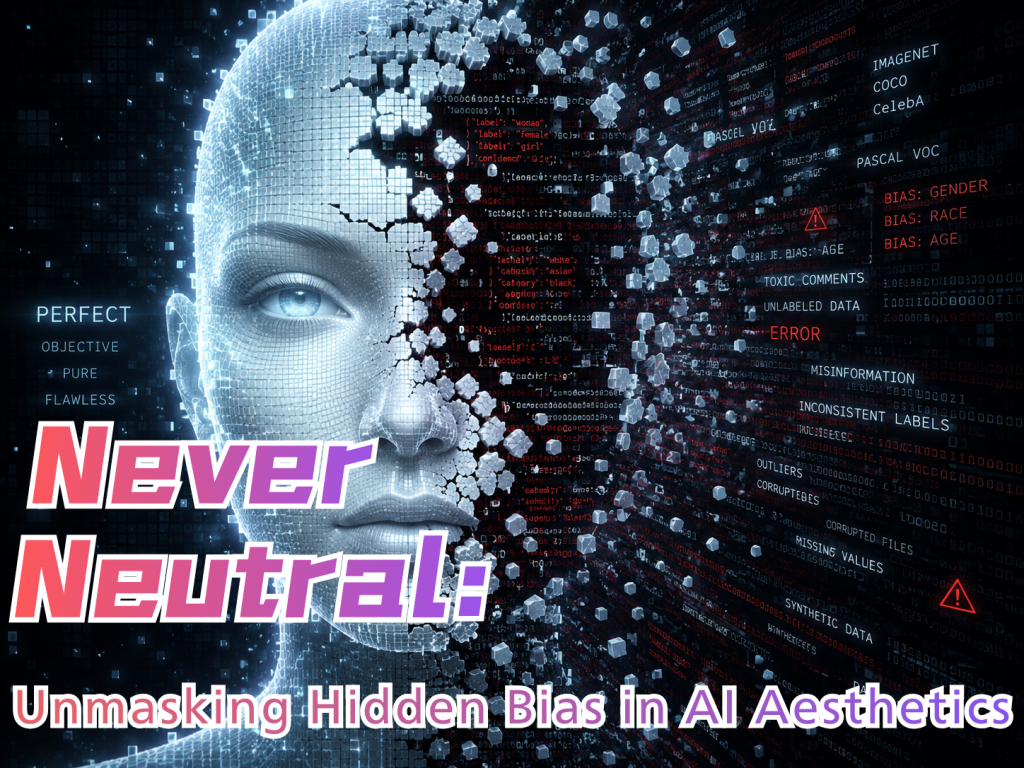
While many people believe that Artificial Intelligence are objective as machines, our research shows that AI restricts beauty standards in the data used to train it. When generating images of women, AI often repeats and strengthens narrow aesthetic prejudices. This process constructs a “default” version of femininity and organizes who is valued and who is pushed to the margins of society. We utilized an AI Face Generator library on Github to test how image models respond to specific prompts and default settings. (https://github.com/pranavkvgit/AI-Face-Generator )
From a visual perspective, AI models often default to Eurocentric beauty norms, such as lighter skin and slim bodies, while frequently missing black women or sexualizing Asian women. To understand the technical cause of this, we interviewed an AI image trainer who explained that these AI models do not follow moral rules. Instead, they learn through mathematical correlation. Because popular images in magazines and online are dominated by light-skinned subjects, the AI builds a link between beauty and those specific features. While Black women are frequently missing from these outputs, Asian women are often subjected to sexualization that reduces their complex identities to eroticized implication. Those visual objectifications are a direct form of disempowerment. It deprive minority groups of their individual and replaces their authentic voices with biased digital caricatures. The algorithmic bias has real-world consequences that lead to the loss of right of minority groups. When the mainstream aesthetic ideology is the only thing the data repeats, minority groups are systematically erased from the templates of our future.
We draw inspiration and theoretical support from several key sources. Organizations like the Concept Art Association highlight how AI models often scrape data without consent. Their work parallels our concern regarding the loss of agency for minority groups. Our project supports legislative action like AB 412, the AI Transparency Copyright Act. This bill requires AI developers to be transparent about their datasets. This act has passed the California State Assembly. We believe that only through transparency and active intervention can we challenge a single aesthetic and ensure that technology serves everyone fairly. We encourage everyone to reflect on who is missing from the images AI creates and to consider the responsibility of developers in building a future that serves all of humanity, not just those already in power.
Leave a Reply
You must be logged in to post a comment.