For this purpose, Healing as Resistance is a praxis project for Black women’s mental, reproductive, and general health in the United States. Rooted in antiracist, anticolonial feminist and queer/trans-feminist perspectives, our work begins from the understanding that Black women’s bodies have long been sites of medical violence, neglect, and resistance. Drawing on intersectionality (Crenshaw), Black feminist thought (Lorde; Collins), and Fanon’s analyses of colonial violence and psychological suffering, we approach health not as an individual outcome but as something produced through racism, sexism, class, labor conditions, and history.
This project was motivated by the persistent gap between academic discussions of medical racism and the everyday knowledge Black women already hold about their own health, as well as by a desire to engage that knowledge without extracting from it. Our group brings together people with different racial and social positions, with one of us being a Black woman engaged in antiracist feminist work elsewhere, and others who are not Afro-descendant but are nonetheless politically shaped by and implicated in Black women’s health struggles. Rather than claiming neutrality, we foreground these unequal positionalities and reflect on how our access to institutional resources as students at a well-resourced university might be used to amplify Black-led work rather than overwrite it.
Guided by Sara Ahmed’s feminist ethics of care, our role has been to practice listening, accountability, and discomfort, resisting the pressure to produce quick “solutions” that would ultimately re-center us. Methodologically, the project integrates academic study, interviews, and sustained community participation. Through ongoing dialogue with the California Black Women’s Health Project (CABWHP), the Office of Black Student Affairs (OBSA), and Blaremont Magazine, and through interviews with CABWHP staff including a director of fund development and a mental health program manager, we came to better understand how chronic racial stress, medical bias, funding structures, and institutional policies shape Black women’s health outcomes.
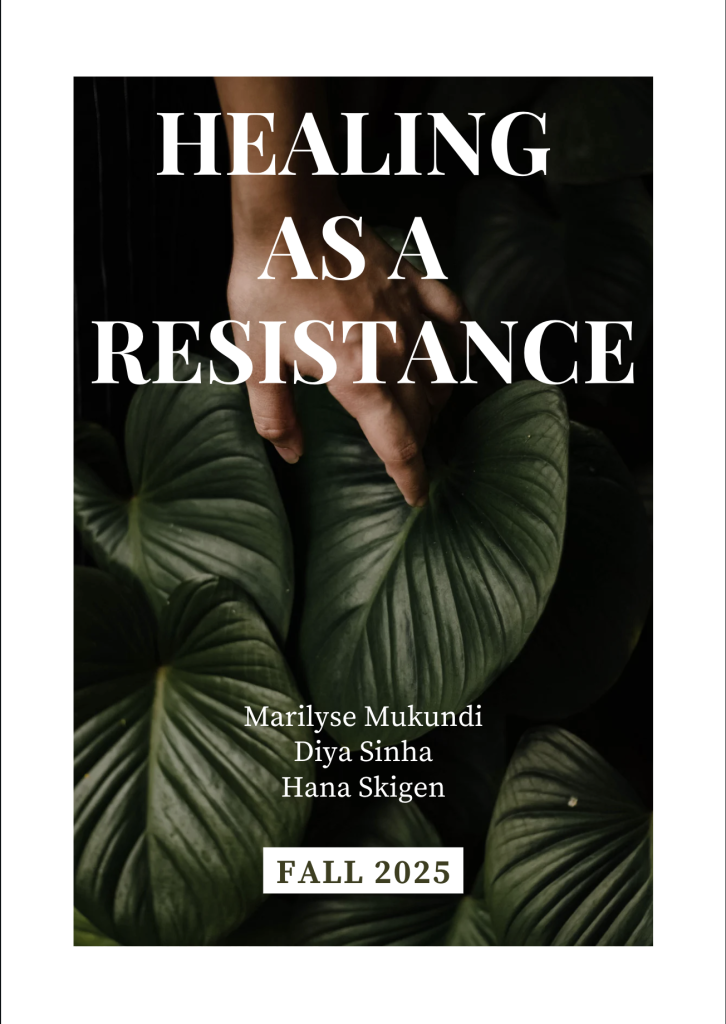
These conversations, alongside course readings on obstetric racism, medical violence, workplace harm against Black nurses, and intersectional health disparities, reinforced a key finding of our work: that harm operates at every level simultaneously, from individual clinical encounters to labor conditions and the law, in ways that communities already recognize and name. In response, we developed our primary intervention in solidarity: an artistic magazine/zine focused on Black women’s mental and reproductive health in California. Created in collaboration with CABWHP, OBSA, and Blaremont, the zine functions as a political and healing tool, using art, photography, testimony, and accessible writing to challenge medical dismissal, expose structural violence, and center Black women’s voices as sites of theory and expertise.
We intend for the zine to be distributed at OBSA events, displayed in campus art spaces, and used as a potential fundraising tool, with proceeds supporting advocacy for Black women’s health. In this way, the project links knowledge production to material support rather than treating awareness as an endpoint. Throughout the process, we were surprised by how much ethical collaboration required slowing down—being transparent about timelines, respecting organizational boundaries, and accepting that tension between institutional and community rhythms is not a failure but an inherent part of coalition work. From this, we offer several take-home practices for audiences: listen to Black women as experts on their own health, question the supposed neutrality of medical institutions, support Black-led health organizations materially, and understand care as collective, political, and historically situated. Placed in conversation with Black feminist and anticolonial theory, Healing as Resistance advances feminist praxis by refusing extractive research models and treating solidarity as an ongoing responsibility rather than a symbolic stance. If healing is an act of resistance, then this project is a small effort to create spaces, on campus, in print, and online, where that resistance can be seen, supported, and sustained.
References
Arriola, Kimberly R. Jacob, et al. “The Health Status of Black Women: Breaking through the Glass Ceiling.” Black Women, Gender + Families, vol. 1, no. 2, 2007, pp. 1–23. JSTOR, www.jstor.org/stable/10.5406/blacwomegendfami.1.2.0001. Accessed 19 Nov. 2025.
Campbell, Courtney. “Medical Violence, Obstetric Racism, and the Limits of Informed Consent for Black Women.” Michigan Journal of Race & Law, vol. 26, special issue, 2021, pp. 47–74. https://doi.org/10.36643/mjrl.26.sp.medical.
California Black Women’s Health Project. “Reparations.” California Black Women’s Health Project, 2024, www.cabwhp.org/reparations.html. Accessed 19 Nov. 2025.
Dill, Jennifer. “Structural Racism and Black Women’s Employment in the U.S. Health Care System.” Health Affairs, 2022 Doherty, Alcindor, and Bain. “‘We Weren’t Heard Until It Was Too Late’: Navigating Inequities in Healthcare as Black Women in the U.S.” Undergraduate Review, vol. 19, 2025, pp. 139–149.
McKoy, J. “Racism, Sexism, and the Crisis of Black Women’s Health.” The Brink, Boston University, 31 Oct. 2023. National Black Nurses Association. “Workplace Violence Regulations for Healthcare Facilities Go into Effect April 1.” National Black Nurses Association, 2024, https://nbna.org/workplace-violence-regulations-for-healthcare-facilities-go-into-effect-april-1/.
NU-MAC. “Supporting the Physical and Mental Health of New and Expectant Black Mothers.” Northwestern University Counseling and Psychological Services, 8 Nov. 2018, counseling.northwestern.edu/blog/mental-health-counseling-black-women-pregnancy/.
Schumacher, Samantha, et al. “Five Facts about Black Women’s Health.” KFF, 7 May 2024. Washington, Alexis, and Jennifer Randall. “‘We’re Not Taken Seriously’: Describing the Experiences of Perceived Discrimination in Medical Settings for Black Women.” Journal of Racial and Ethnic Health Disparities, vol. 10, 2023, pp. 883–891. https://doi.org/10.1007/s40615-022-01276-9. White, Emily. “Racial Disparities in Women’s Health.” Network for Public Health Law, 1 Aug. 2022.