Author: Piya Chatterjee

  • The History of Medical Reproductive Injustice in the United States: The Exploitation of Black and Indigenous Women

    by Ronan Kiernan-Johnson, Rosa Graham, Sophie Callahan, Yuan Li, and Lauren Lee 

    Medical violence and injustice are pressing issues in the United States today, especially against women of color. Many people don’t know the background of this injustice and how it is grounded in the history of the United States, and how colonialism has forced Black and Indigenous women to face difficulties regarding their bodily autonomy and medical rights as a whole.

    Our project aims to understand and explore the deep-rooted history of medical reproductive injustice in the United States, specifically directed towards Black and Indigenous women.

    When starting the project, we were all very interested in medical injustice and wanted to learn more about how that affected different races, so we decided to team up. We decided to display our final product in a zine, where there was information that was comprehensible to the viewer, with a portion of resources at the end. We added resources that not only allow our viewers to understand the history of medical reproductive injustice in the United States, but also have the tools to reach out and learn more about the issue if they so please.

    In our group, we had five members, so we decided that two members would explore medical reproductive injustice towards Indigenous women, and the other three would explore medical reproductive injustice and how that has affected Black women throughout history in the United States. We decided to conduct individual research on subtopics related to the different races we were investigating, and then brought them together to draw similarities and intersectionality.

    For example, we decided to focus on the displacement of Black midwives, the historical roots of gynecology, reproductive medical racism against black women, Colonization and Oppression on Indigenous women’s bodies, reproductive health, and lives, and the sterilization of Indigenous women. We were able to find lots of interesting things that helped shape our understanding of medical reproductive injustice in the United States, and something that we were able to understand more deeply is the intersectionality between the two groups, and how gender and colonialism have shaped this injustice.

    Although there are clear differences specific to each group, we were able to find a lot of underlying similarities that demonstrate how colonialism has shaped the United States and has left a lasting impact. This furthers anticolonial feminist thought by demonstrating how medical injustice has played a large role in racism and misogyny in the United States.

  • Militarized Sexual Violence in Imperial Japan: The Comfort Women Issue

    by Anonymous

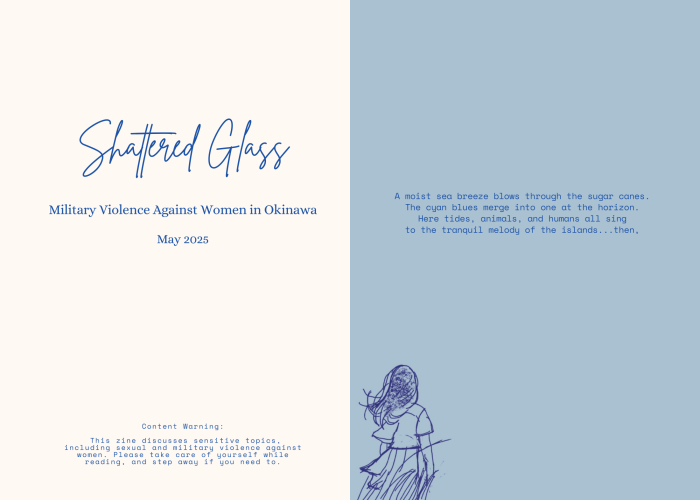
    For our project we created a syllabus to be used in a college course on militarized sexual violence in Imperial Japan.

    This issue is extremely under taught and many survivors were silenced for the majority of their lives. We wanted to bring this issue to a college setting that can be replicated in universities across the world. We provided specific readings for each week that explore different topics and spark critical conversations.

    Overview

    Starting during World War II, the Japanese military implemented the largest case of militarized sexual slavery ever recorded. Hundreds of thousands of Korean girls and young women were forced from their homes where they were then raped, beaten, and abused by Japanese soldiers. Some were forced to serve 50-60 men per day, and those who tried to escape were tortured publicly to set an example for others.

    Impacts

    The abuse that comfort women endured created lifelong trauma, including high rates of infertility, PTSD, and chronic depression. Some studies suggest that the effects of this trauma are passed down generationally through epigenetics. Exposure to stress can alter expression of certain genes that affect stress regulation, which is then passed down to offspring. Many survivors also feel a strong sense of shame about their past, causing them to stay quiet about their experiences. Additionally, symptoms of trauma can be unintentionally passed down through the parenting methods of trauma survivors, namely parental modeling of guilt, which leads to feelings of shame and guilt in children.

    Activism

    Starting in the 1990s, survivors began to come forward and share their experiences. Several women have testified in front of the US House of Representatives about the abuse they suffered, and urged the Japanese government for a formal apology. Since then, many movements have emerged to advocate for the topic. The organization CARE is involved in advocacy and activism in both the United States and South Korea and has urged the Japanese government to take legal responsibility for the abuse they perpetrated. They have also created curriculum outlines to teach about the history of comfort women in California public high schools.

  • The Prison Industrial Complex (PIC) and Why PIC Abolition Is Critical

    by Ruby Ching, Violet Brindis-Reich, Cece Li, and Libby Hansen

    The term “Prison Industrial Complex” (PIC) was coined by Angela Davis to describe the overlapping interests of government and industry that use surveillance, policing, and imprisonment as solutions to economic, social, and political problems, all for profit.


    The prison industrial complex is deeply intertwined with colonialism, both through the direct continuation of colonial-era social control tactics and the development of new systems that criminalize colonized populations. This is most evident through the legacy of slavery and the systemic dispossession of Native Americans in this country.

    Currently, the prison industry in America continues to disproportionately impact minority groups on the basis of race and gender. The prison industrial complex is a capitalistic machine that continues to profit off of individuals who are incarcerated, off of the exploitative labor of those individuals, and the continued emphasis on for-profit prisons, as opposed to social justice minded rehabilitation programs.

    The population of women in prisons is continually rising. According to the Human Rights Watch the number of women entering U.S. prisons has risen by nearly four hundred percent since 1980, which is double the incarceration rate increase of males. Every single woman in prison is at risk of experiencing gender-based violence, sexual abuse, and rape. To put this into perspective, roughly 200,000 adults are sexually abused behind bars every year in the U.S. Additionally, a report from the Bureau of Justice Statistics (BJS) covering the years of 2009 to 2011 found that while women made up only 13% of the jail population, they accounted for 67% of the victims of staff-on-inmate sexual abuse. Through this educational zine, we hope to educate our community on these issues and how we can all be a part of the abolition of the prison industry. ​

  • Portrayal of Various Groups of Sexual Assault Survivors on Social Media

    by Anonymous

    Sexual assault is a serious problem in society and with the globalization of social media, it has only become worse. As college students, and thus a part of the most vulnerable populations to sexual assault, we wanted to research sexual assault and its portrayal on social media. We looked at:

    1: Who was most often affected by sexual assault

    2: Whose stories were prioritized in the media (and whose were not)

    3: How the media spread these stories and manipulated them

    4: How victims are often blamed for their assaults after sharing their stories.

    We created a mobile that physically represents the portrayal of sexual assault survivors in the media and the hierarchy that is present. Within this mobile there are five aspects: the men who control social media, the ideal victims portrayal on social media, BIPOC victims portrayal on social media, LGBTQ+ victims portrayal on social media, and the victim blaming that all survivors face. ​

  • Development of Male Contraception

    by Anonymous

    Birth control and family planning have been a vital but controversial topic for a long time, but even more so since the overturning of Roe vs Wade in 2022. Since women’s choices and rights are being stripped away it begs the question:

    Why is contraception a woman’s responsibility in the first place?

    Historically, contraception has been used for eugenics and ethnic cleansing. Essentially it was also used to control women’s bodies, just in the opposite direction as the modern day. There are still many places, particularly border control facilities, that use forced sterilization and exploit contraception, but birth control as a whole has mostly a positive connotation now.

    However, it is still extremely outdated. Most forms of contraception either are not very effective or have a lot of unwanted side effects, and people with male anatomy only have two options; condoms or a vasectomy.

    It is important that men at least share the responsibility of contraception since women bear the full burden of pregnancy and often the majority of labor and time that goes into raising a child.

    There is demand for male contraceptive options, but not much funding, and the world is becoming more conservative, putting many scientific discoveries, especially those that are more progressive, at risk. Despite all of these issues, there are a few companies with products in development, two of them being in the final stages of clinical trials. One is an oral pill that stops sperm production, and the other is an injection of gel that prevents sperm transport. ​

  • Art as Resistance to Gender-Based Violence through the Films of Iran, India, and the United States ​

    Art as Resistance to Gender-Based Violence through the Films of Iran, India, and the United States ​

    Chloe Mossey, Betania Demisse, Millie Magnolia Treadwell, and Manya Ganapathy

    In our collage, we aimed to educate our peers about the unique feminist issues that extend beyond western perspectives, as well as underscore the role of film in shaping foreign audiences’ perspectives on these issues.

    We watched, analyzed, and placed into conversation the films: The Seed of the Sacred Fig and Holy Spider from Iran, Pebbles, The Great Indian Kitchen, and Sleelatahanir Pore from India, and The Hunting Ground and The Invisible War from the United States.

    The issues of religious fundamentalism, protests against autocratic governance, and the voices of survivors of gender-based violence frequently exist in isolation from one another. Because our project highlights the ways in which women across the world empower themselves against unique forms of violent oppression, we are able to foster a greater appreciation for feminisms beyond the United States as well as appreciation for the artistic outputs of diverse filmmakers.

    By focusing on the most emotionally impactful frames of each of our films (i.e. artful cinematography, expressive acting/interviews), we demonstrate the empathetic power of film that supersedes short-form media and extends beyond political divisions. We found that through our focus on visuals, we could express the feelings of women across India, Iran, and the United States and promote empathy and open-mindedness that could be the start of research pursuits for many individuals. Placing issues that are unknown to many of the students of the Claremont Consortium in conversation with one another through collage helped us to better understand the similarities of both patriarchies and feminist movements across the world.


    Beyond understanding the similarities between these nations’ feminist issues to foster greater empathy, our highlighting of the legacies of colonialism and its consequences in Iran and India helps bring in a new anti-colonial perspective on feminism. Conflicts between colonial hierarchies in India and Iran and traditional social norms (i.e. colorism, rejection of secular social structures) are foreign to many western audiences, and film can be the empathetic medium that sparks greater understanding and curiosity about these issues.

    Our hope is that students of the Claremont Consortium from various areas of study (i.e. media studies, international relations, politics) can grow from our synthesis of global feminist issues. In an era of rising global conservatism and the use of social media for promoting activist pursuits, we hoped to highlight the importance of film analysis, starting with ourselves.

    References

    Abbasi, A. (Director). (2022). Holy Spider [Film]. Profile Pictures; One Two Films.


    Baby, J. (Director). (2021) The Great Indian Kitchen [Film]. Dhoomam Films. Dick, Kirby. “The Hunting Ground.” IMDb, 2015, www.imdb.com/title/tt4185572/.


    Dick, Kirby. (Director). (2012) The Silent War [Film]. Profile Pictures; One Two Films.


    Fouladiyan, M., & Kaboli, A. (2025). Experience of violence perception among Iranian female sex workers and their strategies in confronting violence. Women’s Studies International Forum, 111, 103127. https://doi.org/10.1016/j.wsif.2025.103127


    Mitra, R. (Director). (2021). Sleeletahanir Pore [Film]. Mohtasham, D. (2023, January 4). A man killed women he deemed ’immoral’—An Iranian film fictionalizes the story. NPR.


    Rasoulof, M. (2024). The seed of the sacred fig [Film; alternately Germany/Iran/France]. Produced by Mohammad Rasoulof, Amin Sadraei, Jean-Christophe Simon, Mani Tilgner, & Rozita Hendijanian.


    Sharma, N. (n.d.). ‘Woman, life, freedom’: What the mahsa amini protests signify for iranians – the retriever. Retrieved December 9, 2025, from https://retriever.umbc.edu/2022/10/woman-life-freedom-what-the-mahsa-amini-protests-signify-for-iranians/


    Vinothraj, P. S. (Director). (2021). Pebbles [Film]. (Nayanthara, Vignesh Shivan, K. S. Mayilvaganan).

    External image links:

    https://www.nytimes.com/2018/09/18/business/mcdonalds-strike-metoo.html (me too movement)

    https://baltimorefishbowl.com/stories/maryland-protesters-tell-trump-and-musk-to-keep-hands-off-their-communities/ (we will not be silenced)

    https://www.upbeacon.com/article/2018/10/sexualassaultsurvivor (I am a survivor)

    https://www.genderanddevelopment.org/uncategorized/feminist-protests-and-politics-in-a-world-in-crisis-our-new-issue/ (feminist protest)

  • Creating Revolutions T-Shirts

    by Anonymous

    We created a collection of 70 T-shirts and 200 printed flyers using printmaking to historicize forgotten activist histories at the Claremont Colleges, connecting students, faculty, staff, and community members to ongoing scholarly dissent and institutional oppression. The shirts feature archival images of student demonstrations, dates, locations, and headlines documenting dissent, while the flyers include educational content and a collective artists’ statement. 
     
    On December 4th, we gathered in Seal Court wearing and distributing these shirts to collectively memorialize and resist institutional erasure. We ran out of shirts within minutes of distribution. Our project arises from confronting punitive administrative responses to student expression. It reimagines public art as feminist and anti-colonial, balancing visibility and safety under surveillance. T-shirts, historically tied to dissent, serve as wearable art fostering solidarity and challenging capitalist commodification of activism. 
     
    Our work also reflects on global clothing economies and the colonial dynamics embedded in our campus structures. We resist the appropriation of movements for institutional branding. The designs draw from student archives to reclaim our colleges’ histories without exploiting them for institutional gain. Through collective creation, we center(ed) continuity, solidarity, and intentional production that resists both exploitation and colonial paradigms.
  • How to Make a Quilt

    by Kahtya Cherney, Zoe Moss, India Reinhardt, Eliana Goldfarb

    “How to Make a Quilt” is an art piece meant to call attention to quiltmaking as a process and artform that facilitates a resistance through radical narration and reimagining of the world. 
     
    Through deliberate choice of matching the words of revolutionary thinkers and organizers with the technical methods of quiltmaking, the piece highlights the rich history of quiltmaking, and explores it as a medium for anticolonial work. Throughout our research, we have come across many examples of quiltmaking being used in this way, by women experiencing marginalization at the hands of colonialism and imperialism, as well as their repercussions (e.g., racialized oppression in the U.S.). 
     
    Our piece is intended to be a call to action, in a similar manner to the end of Saidya Hartman’s The Plot of Her Undoing. Hartman depicts the “undoing of the plot” (the plot being the complex, nonlinear patterns of oppression that uphold systemic violence, exploitation, and erasure of women of color, including colonialism, imperialism, and racism). She finishes the piece by writing. “The undoing of the plot begins with her runaway tongue, with her outstretched hands, with songs shared across unfree territory and the occupied lands, with the pledges of love that propel struggle, with the vision that this bitter earth may not be what it seems.” Hartman highlights the collective power of women, who resist oppression and erasure through faith and commitment to a different reality. 
     
    Our final piece is intended to honor the way women throughout history have used quiltmaking to undo “the plot” in this way, who have collectively crafted and memorialized their own version of the world; and to inspire viewers to do the same. It argues that anti-racist feminist art need not always include explicit references to specific histories or identities. Here it takes a more stealthy form, a call towards action, towards revolution, under the guise of feminine “craft”. 
     
    We thought intentionally about what fabrics to use and what forms for our collective quilt. We discussed the idea of following a more uniform vs. independent structure in terms of color and pattern. In the end, we decided that our final quilt would feel most successful if we used only found fabric scraps and each chose our own colors, allowing our individual efforts to be seen independently in a final collaborative process and practicing “repurposing.” Quilts were often relics of a community’s life, pieced together by discarded textiles and old clothing. We chose to keep this in mind and did not purchase a single new element during our process from start to finish. In the consideration of “quilting as craft,” we chose to create our own form that responded to its historical veracity in a meta and intentionally stripped down way; providing instructions typically associated with teaching a craft but exchanging basic language with quotes of Saidya Hartman’s, as well as some words inspired by The Chilean Arpilleristas and the women of Gee’s Bend Quilting Collective. We also chose this quilting medium to respond to the definition of craft as a job that requires skill and experience, because most of our group had never had exposure to quilting or even sewing before. This moment in time allowed us to work together, teaching each other and experimenting for the first time, to create something that responds to and defies the conformities of craft. 
     
    Born out of necessity, the art of sewing and piecing together a quilt has historically been a way for groups of women to find assembly and community, and in making our own quilt, we were able to feel a newfound sense of connection within our group. “How to Make a Quilt,” was deliberately planned to be exhibited in a public, well used space in order to represent the piece as not only accessible, but in direct opposition to the idea of the ‘fine arts’ that one may find in a museum. Instead of confining the piece within an exclusive gallery, the display and creation of the quilt is by the people, and for the people. The theory behind the ‘elevated canon’ of arts directly ties to a few key points, and themes, that the quilt actively undermines. For example; What kind of visual media has Western culture traditionally idolized? Why are some pieces of art considered ‘fine’ whereas others are ‘trades’, or ‘crafts’? What contributes to this visual artistic hierarchy, and is it correlated to deeply rooted systems and tools of oppression? 
     
    “How to Make a Quilt,” is a piece that does not attempt to play into these standards of the ‘fine art’ gallery space, or, as Brian O’Doherty once coined in his famous essay from 1976, the ‘white cube’. The white cube is a term that references the practice of removing art from its context entirely and placing it within an exclusive blank display room, such as within a museum, instead of showing the art within an environment more natural and relational to the piece itself, which is linked directly to exploitative colonial practices such as piracy. Instead, sharing the quilt by pinning it up within a more unconventional, well-used, and community oriented space could elevate its meaning radically; this quilt is for all, not just a select few. 
     
    From the initial intent and thinking behind “How to Make a Quilt,” down to the communal nature of its execution, and deliberate usage of scrap material, the final piece reflects a radical interruptance to the Western arts’ canon. Sewn by separate hands and joined together in an act of unity, engaging in a re-usage of old clothes, and pieces of fabric left behind from past projects (which are not often considered viable mediums for a ‘formal art project’) the project is a homage to communities and individuals of the past, present, and future, who have used sewing to express their love, joy, dedication, and employed the quilt itself as a radical messenger and agent of change. “How to Make a Quilt” aims to celebrate the legacy of people who have used quilting to challenge oppressive systems and create spaces for resistance and healing. Our quilt is a testament to the enduring power of art as a tool for revolution, inviting viewers to reflect on the ways in which seemingly everyday practices can be transformed into powerful acts of defiance and community building. 
     
    To learn more about our inspiration for this work, we encourage continued reading of these resources: 
     
    Garieri, R. (2019, March 17). Writings of Subversion: The Chilean Arpilleristas. AWARE: Archives of Women Artists, Research and Exhibitions. https://awarewomenartists.com/en/magazine/ecritures-de-la-subversion-les-arpilleristas-chiliennes/ 
     
    Graceffo, L. (2021, July 16). Preserving a people’s history through quilts. Waging Nonviolence. https://wagingnonviolence.org/2021/07/preserving-a-peoples-history-through-quilts/ 
     
    Hartman, S. (2020). The Plot of Her Undoing. Notes on Feminisms, Feminist Art Coalition. O’Doherty, Brian. (1976). “Inside the White Cube: Notes on the Gallery Space, Part I.” Artforum, Artforum, 26 Sep. 2023, www.artforum.com/features/inside-the-white-cube-notes-on-the-gallery-space-part-i-214843/. 
    Sohan, V. K. (2015). “But a quilt is more”: Recontextualizing the Discourse(s) of the Gee’s Bend Quilts. College English, 77(4), 294–316. http://www.jstor.org/stable/24240050
  • Korean Comfort Women: Collaboration with Washington Coalition for Comfort Women

    by Charlotte Hahm

    Throughout World War II, over 200,000 young Korean women were kidnapped and coerced to serve as sexual slaves in military brothels throughout Asia and the Pacific by the Japanese military and government. These women, referred to as “comfort women,” endured years of sexual exploitation and complete dehumanization only to be murdered and silenced after the war. Today, less than ten registered Korean comfort women survive. 

    To combat the Japanese government’s intentions to erase this tragic and horrific history, I have collaborated with members and friends of the Washington Coalition for Comfort Women issues (WCCW) to highlight the comfort women’s voices and not let their stories go untold. My grandmother and grandfather, Dong-Woo Hahm and Doo-Chan Hahm, co-founded the WCCW and dedicated the latter half of their lives towards fighting for recognition and compensation for Korean comfort women. My grandmother and all of the Korean comfort women’s struggles were fueled by their desires to find their political power in a climate that constantly silenced them. I too was fighting from the positionality of a young, Korean-American woman, however, as an American, I have the power to use my voice without the same fear imposed by the U.S. government. This positionality helped me discover the most effective way to use my power publicly and share this history without being ignored due to my identity. 

    Our collaborative work has focused on collecting my grandmother’s archives from her work with Korean comfort women and attempting to digitize and share her information with the general public. In this way, we can highlight the individual voices of the Korean comfort women, redistributing to them the power of their voice that was once stripped away while also utilizing the internet as a means of spreading information without discriminative barriers. Throughout this ongoing process, communication has been imperative to ensure that each archive discovered is thoroughly reviewed and handled with care across the state-wide barriers that divide our workforce. I am stationed in California, whereas many of the materials are located in Florida. The material is also a form of my grandparents’ intellectual property, so we are discussing ways to share their archives while recognizing their incredible efforts to collect the information. This process has allowed me to continue my grandmother’s legacy and find community among her organization’s succeeding leaders. I also was able to collaborate with another researcher of comfort women issues who focused on Chinese comfort women. This allowed me to continue expanding my own knowledge of Japanese militarism and comfort women history. I hope that we can build solidarity across our fights for comfort women issues, and fight together for recognition of the expansive sexual military crimes committed against women across the globe. If you are interested in following this process to digitize interviews, photographs, videos, and other archives, please reach out to the WCCW’s leaders to connect with me, and stay alert for more information to be shared on their website.